Choose air, sea or a split shipment for custom sweaters by comparing the same origin-to-warehouse scope. Start with the latest useful arrival date, then confirm finished and quality-released quantities, carton dimensions and weights, current carrier schedules, customs requirements, destination charges and inventory value at risk. Air is not automatically the correct rush solution, and ocean is not automatically cheapest when delay or unusable assortments are included.
Define the arrival event that matters
Write the destination, time zone and required event: carrier handover, flight or vessel departure, customs release, warehouse receipt, wholesale appointment or retail launch. A quoted port-to-port transit does not answer a door-to-warehouse requirement. Include the receiving calendar and latest date on which the stock still has commercial value.
Work backward through final delivery, customs, terminal handling, main carriage, export handling, factory pickup, inspection and packing. Keep planned dates and carrier cutoffs as current evidence, not guarantees. Weather, capacity, congestion, inspections and document errors can affect either mode.
Confirm what is actually ready to ship
Use accepted, correctly labeled and packed first-quality quantities by style, color and size. Do not build an air-freight rescue around gross knitting output or cartons still waiting for inspection. Record quality holds, repairs, testing and buyer approvals separately.
For a split, choose a commercially usable assortment. Sending easy sizes or completed colors first can leave the warehouse unable to fill wholesale allocations or display the intended range. State which customers, launch needs or replacement obligations the priority batch serves.
| Decision input | Evidence | Common error |
|---|---|---|
| Required delivery | Named warehouse/event date and receiving window | Comparing only departure dates |
| Ready quantity | Released SKU and carton matrix | Counting unfinished or held goods |
| Freight basis | Gross weight, dimensions, volume and charge basis | Multiplying a guessed per-kg rate |
| Route | Pickup, handovers, main carriage and final delivery | Comparing airport-to-airport with door-to-door |
| Import | Broker, documents, duties, taxes and importer role | Assuming faster carriage means faster clearance |
| Risk | Insurance, transfer point, buffers and fallback | Treating a booking as an arrival guarantee |
Calculate from final carton data
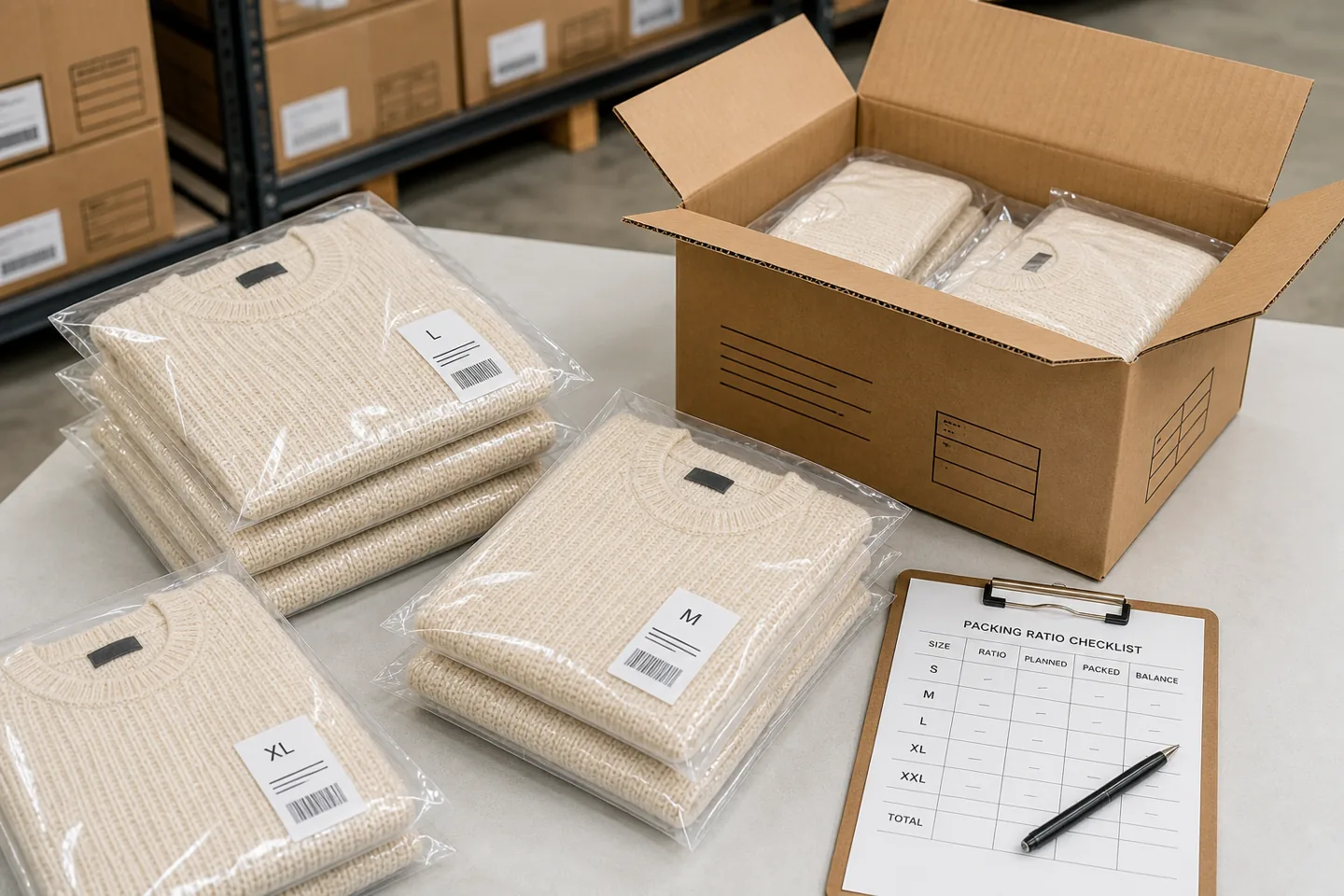
Ask the factory for carton count, external dimensions, gross and net weight, SKU contents and stacking or handling constraints. Sweaters can be bulky relative to their mass, so packing method influences freight. Do not compress garments beyond the approved appearance, moisture and recovery limits merely to reduce volume.
Air quotations may use chargeable weight according to applicable carrier rules rather than scale weight alone. Ocean quotations may depend on full-container or shared-container service, volume, minimums and local charges. Give the same verified cargo data and pickup/delivery scope to each forwarder, and retain the quote's validity and exclusions.
Compare door-to-door cost, not headline freight
Build one worksheet covering factory pickup, export handling, documentation, terminal charges, main carriage, security or fuel-related charges, insurance, destination handling, customs brokerage, duty, tax treatment, storage risk, final delivery and warehouse appointment. Separate pass-through estimates from fixed prices and state currency and validity date.
The U.S. International Trade Administration recommends comparing shipping companies and notes that forwarders can advise on freight, port, documentation, insurance and handling costs. That is why a garment supplier's informal freight estimate should be replaced by a route-specific written quotation before the buyer commits.
Price the timing decision commercially
Estimate the consequence of each credible arrival: missed wholesale cancellation, lost full-price weeks, air-cost premium, markdown risk, stockout, campaign disruption and cash tied in early inventory. Keep these as buyer assumptions with ranges, not claimed certainty. The cheapest transport invoice can still support the weakest business outcome.
Air can be rational for a small, high-priority batch when the remaining selling window supports it. Ocean can be rational when sufficient buffer exists and the quantity benefits from its cost structure. Waiting for the complete order may be better than splitting if the first batch cannot sell independently.
Model a split shipment carefully
Compare complete air, complete ocean, priority air plus balance ocean, priority courier or deferred complete shipment. For each scenario show SKU quantity, carton count, quality release, factory handover, expected warehouse window, total landed cost, documents and remaining-order dependency.
A split creates more than two freight bills. It may require separate inspections, packing lists, invoices, airway bills or bills of lading, customs entries, receiving appointments and balance tracking. Use distinct carton sequences and shipment references, and ensure the second shipment cannot reuse outdated documents.

Keep Incoterms and insurance separate
State the Incoterms® rule, edition and named place for each quotation. It allocates defined delivery obligations, costs and risk but does not itself choose the carrier, guarantee arrival, determine title or automatically provide insurance. Confirm who books each leg, clears export and import, pays destination charges and controls instructions.
Review cargo insurance for the actual mode, route, value, exclusions, deductible, valuation basis and claim duties. Do not infer adequate cover from “freight included.” Photograph pack-out and carton condition, retain quantity records and define how damage or shortage will be noted at receipt.
Freeze documents and handover controls
Before pickup, reconcile the PO, released quantity, packing list, commercial invoice, origin data, tariff classification and transport instructions. Confirm consignee, notify party, addresses, contact details and document-routing deadlines with the importer and forwarder. Faster main carriage cannot recover from a preventable customs-document hold.
Buyer freight-mode checklist
- The latest useful warehouse event is defined.
- Only accepted and released SKU quantities enter the plan.
- A priority batch is commercially usable by itself.
- Final cartons provide weight, dimensions and contents.
- Quotes use the same origin-to-destination scope.
- All local, customs, insurance and delivery lines are visible.
- Current schedules include cutoff and buffer assumptions.
- Complete air, ocean, split and wait options are compared.
- Incoterms®, carrier booking and insurance remain distinct.
- Every shipment has reconciled documents and carton identity.
Yushengda supports EXW, FOB and DDP projects, subject to the confirmed order and route; these terms do not promise a particular freight mode or transit time. Use the Incoterms® comparison, partial-shipment guide and carton test guide, or send the released quantity, carton data, destination and required arrival event for shipment-data coordination.
Primary references: U.S. International Trade Administration, Shipping Options and Common Export Documents, for comparing services, forwarder support, packing, insurance and document alignment; IATA, Air Cargo Provisions Handbook, for chargeable-weight-based rate assessment. Actual routes, rates and requirements require current carrier, forwarder, broker and importer confirmation. Competitor content was reviewed only for buyer questions and gaps; no transit promises, prices, cases, metrics, wording or images were reused.