Test sweater packaging as the complete production pack: garment fold, tissue, tags, polybag, carton count, board, tape, markings and pallet or parcel route. Define acceptable garment and package condition before testing, then choose drop, compression, vibration and climate exposures that represent distribution. A carton drop alone cannot validate stacking, humidity, barcode readability or ecommerce handling.
Start with the route, not a generic carton grade
Map how the goods move after packing. A palletized wholesale carton sent to one distribution center experiences different handling from an individual ecommerce parcel routed through fulfillment, sorting and last-mile delivery. Ocean freight adds long dwell and climate changes; air freight and courier networks add different impacts and dimensional-weight pressures.
Record shipment mode, palletization, stack height, container or vehicle, expected storage, parcel handling, repacking and final customer presentation. If one master carton enters a warehouse and garments later ship individually, validate both the inbound master pack and the outbound consumer pack.
| Distribution risk | Potential sweater failure | Evidence to plan |
|---|---|---|
| Drop/impact | Corner crush, opened tape, shifted garments, broken trims | Defined package orientation and impact sequence |
| Stacking/compression | Collapsed carton, hard fold creases, crushed retail boxes | Load, duration and conditioned carton result |
| Vibration | Garment migration, abrasion, tag or trim snagging | Route-relevant vibration procedure and unpack review |
| Humidity/temperature | Board weakening, label lift, odour or moisture risk | Conditioning or climate sequence tied to route |
| Fulfillment handling | Barcode failure, polybag tear, wrong presentation | Scan, seal and final-customer checks |
Freeze the exact production pack-out
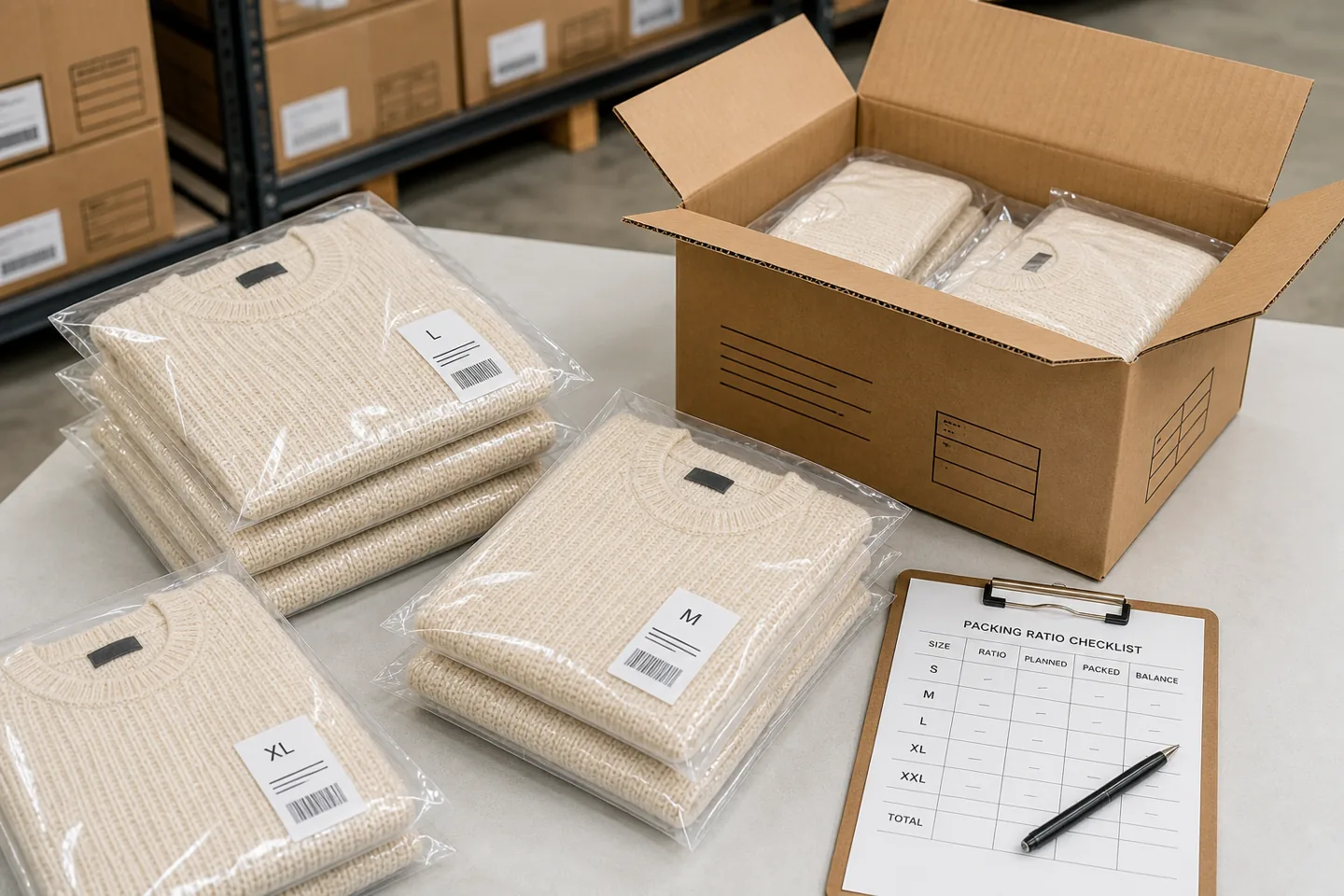
Use the intended sweater size and construction, final fold dimensions, tissue or insert, hangtag position, spare components, polybag material and closure, barcode label, carton dimensions, board specification, liner, tape pattern, garment count, assortment and void fill. A test carton packed with lighter samples or fewer units does not represent bulk.
Record gross and net weight, dimensions and orientation. Photograph the garment before packing, each inner layer, carton loading pattern, closure and markings. If mixed sizes or styles create uneven load, test the actual assortment rather than a convenient uniform carton.
Define damage before the result is known
State what fails the product: permanent crease, distortion, pilling or abrasion, color transfer, broken button or zipper, snag, label damage, moisture, odour, contamination or incorrect presentation. State what package degradation is allowed: cosmetic scuff, dent, torn polybag, open seam, crushed corner, illegible mark or unscannable barcode.
The same dent may be acceptable on an export master carton but unacceptable on a consumer-facing gift box. ISTA's Project 3L overview requires stakeholders to define product damage, allowable damage tolerance and the evaluation method before testing. Apply that discipline even when another protocol is selected.

Use ISO 2248 for a controlled drop question
ISO 2248:1985 covers a vertical impact test by dropping a complete, filled transport package onto a rigid plane surface. Its principle uses predetermined atmospheric conditions, drop height and package attitude. The method therefore requires more control than pushing a carton from an arbitrary table.
Select the height, orientations, conditioning and sequence with a packaging professional, retailer, carrier or test laboratory according to the route and package. Report every impact and specimen identity. A successful result answers the defined drop challenge; it does not prove resistance to compression, vibration, water or all real-world events.
Add other hazards when the route requires them
Stacked warehousing and container transport may justify compression or stacking evaluation. Parcel networks may justify vibration and repeated impact. Humid or changing climates may require conditioning before mechanical tests because corrugated board, paper, labels and adhesives can behave differently after exposure.
Use a recognized distribution protocol or a documented custom sequence selected by qualified packaging guidance. Order matters: conditioning followed by compression and impact can reveal a different weakness from testing a new dry carton independently. Do not combine results from different sequences as though they were interchangeable.
Inspect all three layers after testing
First inspect the outer carton: closure, corners, panels, punctures, wetness, markings and ability to remain handled. Next inspect inner packaging: polybag seal, holes, abrasion, tissue transfer, tag movement and barcode readability. Finally evaluate every test sweater against its pre-test record.
Allow garments to relax for the agreed interval before judging recoverable creases, but do not steam or repress unless that action is part of the receiving process being validated. Scan barcodes with the intended system and compare carton contents with marks and packing list.
Separate wholesale and ecommerce acceptance
A wholesale shipment may prioritize pallet stability, carton integrity, assortment accuracy and efficient warehouse opening. Ecommerce adds consumer presentation, single-parcel sealing, last-mile impacts, returns and the possibility that the branded pack ships without another protective box.
ISTA Project 3L is a general simulation for individually packaged products moving through retailer fulfillment and carrier distribution to the final consumer. It is not automatically the right protocol for every master carton. Name the channel and packaged-product configuration when requesting testing.
Transfer the approved pack into bulk
Issue a controlled packaging specification with component references, dimensions, tolerances, fold diagram, garment count, assortment, tape pattern, labels, marks and approved test report. Check first packed cartons for weight, dimensions and presentation, then sample across packing stations and the production run.
Retest after a material, carton size, pack count, fold, retail box, closure or route change that could affect performance. Keep arrival and damage data by route. Field evidence can guide the next validation plan, but low claims on one lane do not approve a different distribution system.
Buyer transit-pack checklist
- Wholesale, parcel, ecommerce and storage routes are mapped.
- The test uses the exact production sweater and complete pack.
- Weights, dimensions, assortment and closure are recorded.
- Product damage and package degradation limits are pre-defined.
- Drop height, orientation and conditioning follow a named plan.
- Compression, vibration and climate are added where relevant.
- Outer carton, inner pack and garment are all inspected.
- Crease recovery is judged without unapproved corrective pressing.
- Barcodes, markings and carton contents are verified.
- Changes and new routes trigger risk-based revalidation.
Yushengda develops custom knitwear in wool, cotton, acrylic, viscose, cashmere and blends across 3GG–16GG, subject to the project. Use the label and packaging checklist, the shipment moisture guide, or send your pack specification, carton assortment, route and order quantity for an RFQ discussion.
Primary references: ISO 2248:1985, Complete, filled transport packages — Vertical impact test by dropping, confirmed current in 2022, and the ISTA Project 3L overview. Competitor apparel-packaging articles were reviewed only for coverage gaps; their carton grades, test values, damage statistics, images and wording were not reused.