Approve a custom sweater fiber-content label from the destination market backward. For US orders, most covered textile and wool products need accurate fiber content, country of origin and a responsible business name or eligible RN, plus separate care-label compliance. In the EU, Regulation 1007/2011 governs approved fiber names, composition disclosure, visibility and destination language. One artwork should not be assumed compliant in both markets.
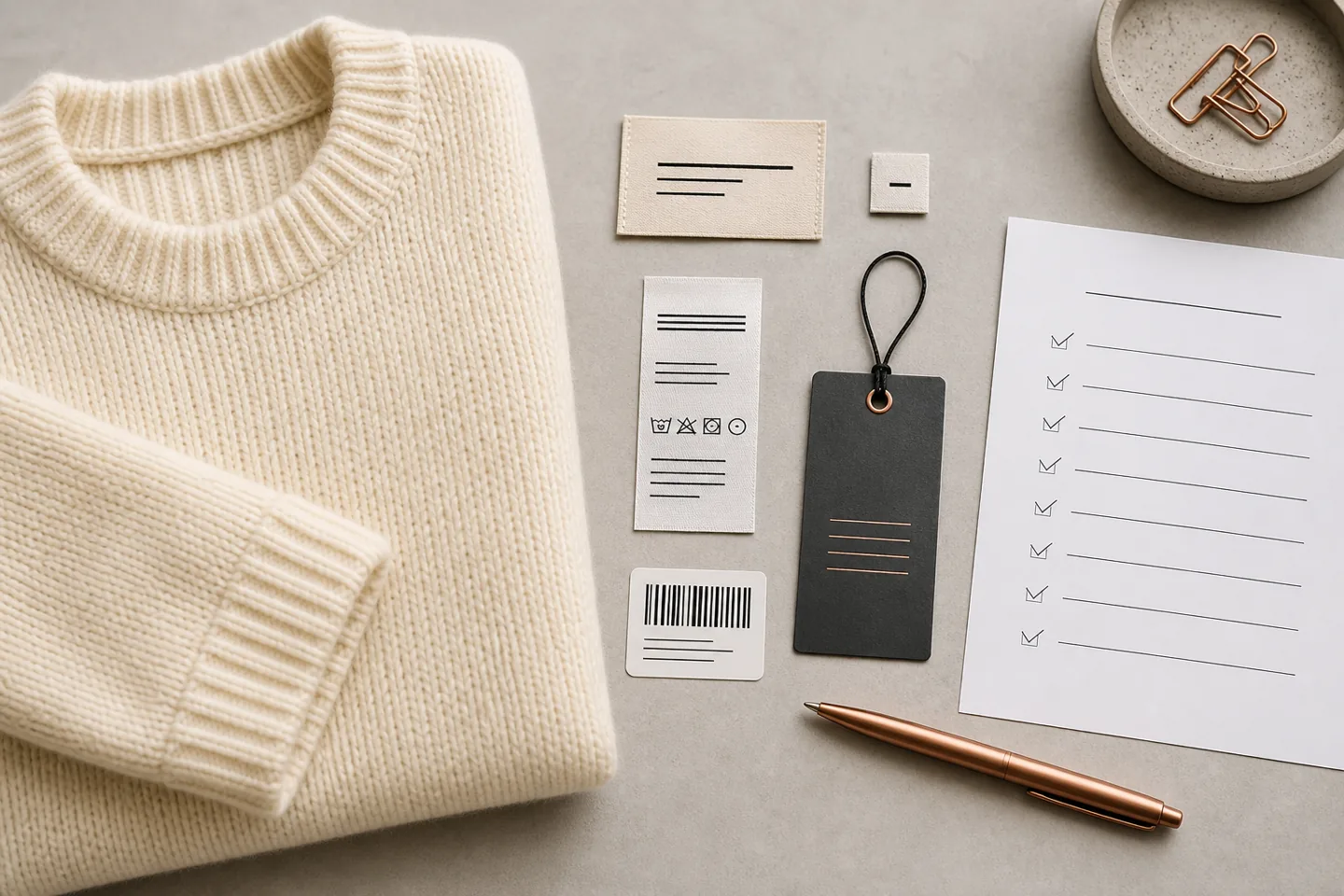
Start with the selling market, not a factory label template
The brand, importer or other responsible economic operator should define the markets where the sweater will be sold and obtain qualified compliance advice for those markets. A manufacturer can reproduce approved artwork and support material records, but should not guess the buyer’s legal identity, registered number, required languages or retail claims.
Create a market matrix by SKU and destination. Record the exact yarn composition, finished-garment components, origin determination, responsible-party wording, care instructions, label language, placement and evidence owner. Keep fiber disclosure separate from optional brand storytelling such as “premium,” “eco,” “Italian-inspired” or collection names; optional claims still need to be truthful and must not obscure required information.
US labels: identify content, origin and a responsible business
The US Federal Trade Commission states that most covered textile and wool products must disclose fiber content, the country of origin and the identity of the manufacturer or another business responsible for marketing or handling the product. The identity can be an eligible company name or an FTC Registered Identification Number. The FTC notes that RNs are issued to qualifying US businesses, not foreign companies, and an RN is not mandatory if an acceptable business name is used.
For imported garments, confirm the correct origin wording with US customs and compliance specialists; do not derive origin from the yarn supplier’s country alone. FTC guidance also describes placement rules for garments with a neck, including origin disclosure at or near the inside center neck. Required disclosures must be conspicuous and accessible, and US disclosures must include English.
US wool and cashmere claims need particular care
A sweater containing wool may fall under the Wool Products Labeling Act and Rules rather than being treated as an ordinary generic textile blend. The FTC’s wool guidance covers specialty wool claims such as cashmere, mohair, alpaca and camel hair. A marketing name or yarn supplier code is not a substitute for the required fiber identity and percentage.
Do not use “100%,” “all” or “pure” because the planned recipe is close to a single fiber. FTC guidance explains that a manufacturing tolerance is not permission to knowingly state an inaccurate composition, and an exclusive-fiber claim does not receive the ordinary tolerance treatment. For wool products, keep supplier declarations and any required composition verification connected to the exact yarn lot and finished style.
EU labels: use the Regulation’s permitted fiber names
Regulation (EU) No 1007/2011 applies to textile fiber names and related composition labelling or marking. The European Commission’s official FAQ says textile products sold in the EU must provide fiber-composition information and use the fiber names listed in Annex I. Brand names and unlisted commercial terms alone do not satisfy that identification requirement.
Terms such as “100%,” “pure” or “all” are reserved for products composed exclusively of one fiber, subject to the Regulation’s limited exceptions. Labels or markings must be durable, easily legible, visible and accessible. The member state where the product is offered can determine the required official language or languages, so “English only for Europe” is not a safe default.
Handle components instead of averaging away differences
A cardigan can contain a main knitted body, contrasting sleeves, lining, detachable trim, embroidery, reinforcement and labels. Do not automatically average them into one convenient percentage. The EU Commission FAQ explains that components with different composition may require separate disclosure when they meet the Regulation’s conditions, including certain components representing 30% or more of total product weight and not being main linings.
US rules also contain detailed treatment for ornamentation, trim and products composed of multiple parts. The applicable calculation depends on the construction and claim. Build a bill of materials that identifies every textile component and its weight basis, then have the buyer’s qualified reviewer decide what appears on the label. Keep decorative exclusions or component statements only when the applicable rule supports them.
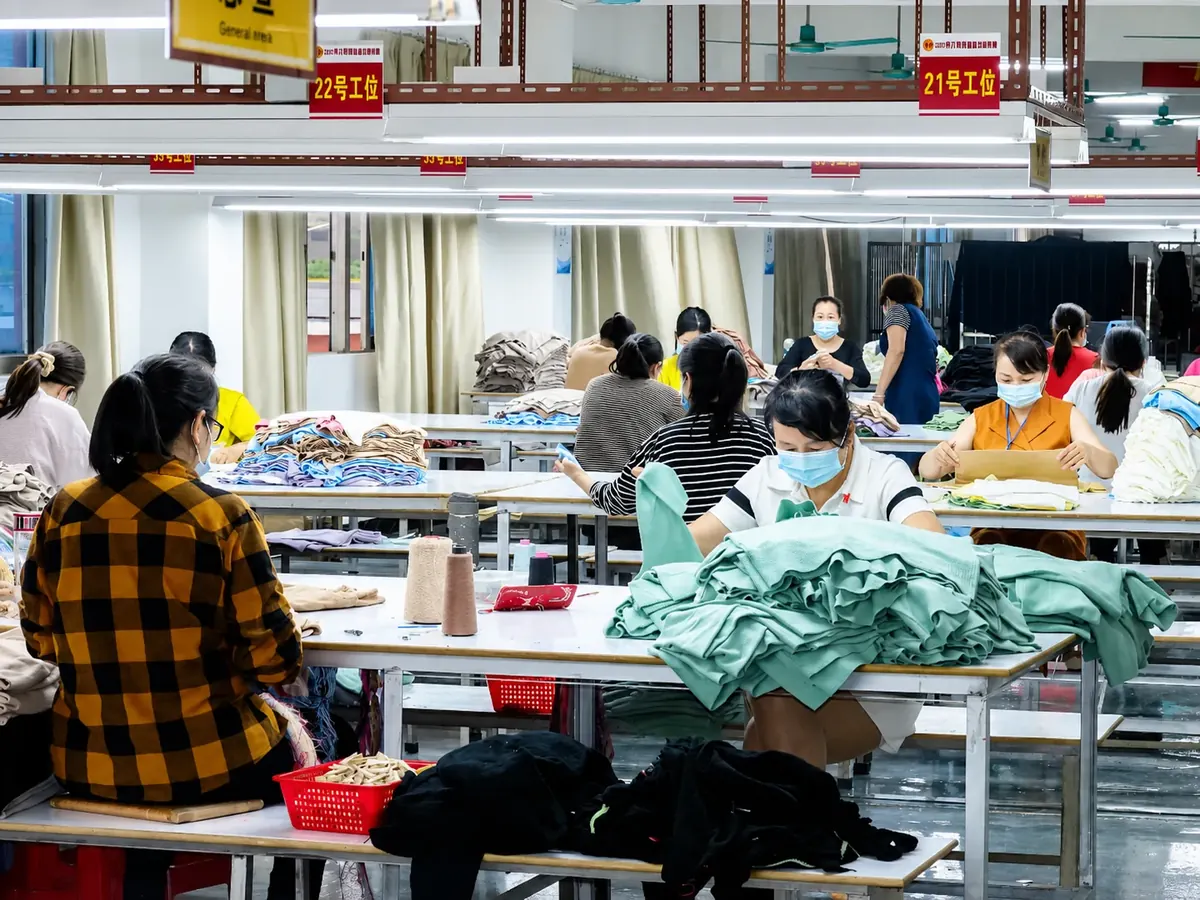
Separate fiber labels from care instructions
Fiber composition and care are related but not interchangeable. In the US, the FTC Care Labeling Rule requires manufacturers and importers of covered wearing apparel to attach care instructions; the fiber-content guidance notes that care information belongs on a permanent label. In the EU, Regulation 1007/2011 itself does not set consumer care-instruction requirements, according to the Commission FAQ. Other laws, national expectations, retailer standards and voluntary systems may still affect the care label.
Select care wording and symbols from the tested finished garment, including its yarn, stitch, trims, color and specialty finish. A yarn care recommendation alone may not represent a washed, sprayed, brushed, embroidered or multi-color sweater. Do not copy a care-symbol row from another style without confirming the complete product.
Build evidence before printing bulk labels
- Freeze the SKU bill of materials and intended sales markets.
- Collect traceable yarn and component composition declarations.
- Confirm the finished garment’s origin with the responsible importer or adviser.
- Select market-approved generic fiber names and percentage order.
- Add the correct responsible-party identity and destination languages.
- Review multi-component, trim and exclusive-fiber claims.
- Approve care content from appropriate testing and brand policy.
- Check artwork size, legibility, front and reverse orientation, and placement.
- Approve a physical pre-production label on the actual sweater.
- Verify bulk labels by style, color and size before packing.
Version-control the final artwork. Record who approved legal copy, composition, care, barcode data and physical construction. If yarn substitution or trim changes alter composition, reopen label approval instead of carrying the old artwork into production. The same applies when one style is redirected to a new market.
What to send with a custom sweater RFQ
Send the destination countries, brand or responsible-party copy, fiber and care artwork, dimensions, material, fold, attachment method, placement diagram and color requirements. State whether the factory should source labels or receive buyer-supplied stock. Yushengda works with wool, cotton, acrylic, viscose, cashmere and blended yarns and can discuss labels within a project-specific quotation; the buyer remains responsible for approving destination-market requirements.
Use the complete label and packaging checklist, the yarn-substitution approval guide, or send your style, composition and destination markets for a label-development discussion.
Official references: the FTC clothing and textiles guidance hub, the FTC guide Threading Your Way Through the Labeling Requirements, EU Regulation 1007/2011, and the European Commission FAQ. This article is operational guidance, not legal advice; rules and product circumstances require market-specific review.