Approve custom sweater labels and packaging as controlled production components, not end-of-order decoration. Buyers should supply destination-market requirements, final artwork, fiber and care information, label placement, barcode data, folding method, bag specification, packing ratio and carton marks before bulk packing. Use approved physical or digital references, then inspect packed goods against one version-controlled checklist.

Separate legal information from brand presentation
A brand label, size tab, composition or care label, hangtag and barcode serve different purposes. Begin with the countries and channels where the garment will be sold. The buyer or importer should obtain qualified compliance advice for those markets and provide the required wording; a factory can reproduce approved information but should not be asked to invent the legal specification.
For US textile products, Federal Trade Commission guidance identifies fiber content, country of origin, and the company name or Registered Identification Number of the responsible business among the core textile disclosures. Garments also fall under the FTC Care Labeling Rule. In the EU, textile products generally require clear fiber-composition labeling, and language requirements depend on the countries where the product is offered. These regimes are not interchangeable, and other product, safety, environmental or national requirements may apply.
Create a label schedule before ordering trims
Build one table for every component: item name, artwork file, finished dimensions, material, colors, fold type, text, placement, attachment method, quantity and approval status. Mark whether the reference is a digital layout, strike-off or physical sample. Custom woven labels, printed care labels, hangtags, strings, seals and printed bags can each have supplier minimums, setup costs and lead times independent of the garment MOQ.
Place labels on a technical sketch with measurements from stable garment points. “At the neck” or “near the side seam” is open to interpretation. State which edge faces upward, whether a label is centered, how much seam allowance is captured and whether stitching may show externally. Check that a stiff or bulky label will not damage the intended handfeel.
Lock fiber, care and origin data to the garment
Do not finalize composition artwork while yarn substitutions or blend percentages remain unresolved. The label must describe the approved product, not the early development brief. Keep supplier material information, the final bill of materials and any required test or compliance evidence together. If a yarn, trim or component changes, review whether label text also needs revision.
Care instructions should match the tested and approved garment construction and finish. Washing, drying or ironing guidance copied from a previous style may be unsuitable for a new yarn, embellishment or specialty wash. Buyers should confirm the care statement and any symbols for the destination market with their compliance adviser; the manufacturer should follow the approved text exactly.
Validate artwork and barcodes as data
Supply usable vector artwork where possible, along with color references and a clearly named final file. Proof spelling, fiber percentages, country names, sizes, punctuation and translations character by character. Prevent obsolete files from remaining in the production pack by adding a revision date or version number.
For barcodes, provide the exact symbology and data assigned by the buyer’s system. Map every code to style, color and size in a master table. A barcode image that looks correct may still scan poorly after printing, resizing or applying it to a curved or reflective surface. Include print size, quiet space, placement and verification requirements in the specification, and test representative production output with the intended workflow.
Define folding and individual packing
A reference photo or diagram is clearer than “standard fold.” Specify finished folded dimensions, button or zipper position, sleeve direction, use of tissue or other supports, hangtag placement and which face is visible through the pack. If moisture-sensitive or delicate finishes require special handling, document the responsible protection method rather than assuming more packaging is always better.
Describe the individual bag or alternative pack by material, dimensions, thickness where relevant, closure, ventilation, printing and sticker position. Claims such as recyclable, compostable or recycled content should be supported for the destination and disposal system; changing material for a marketing claim can also affect clarity, strength and sealing. Keep unsupported environmental claims off the artwork.
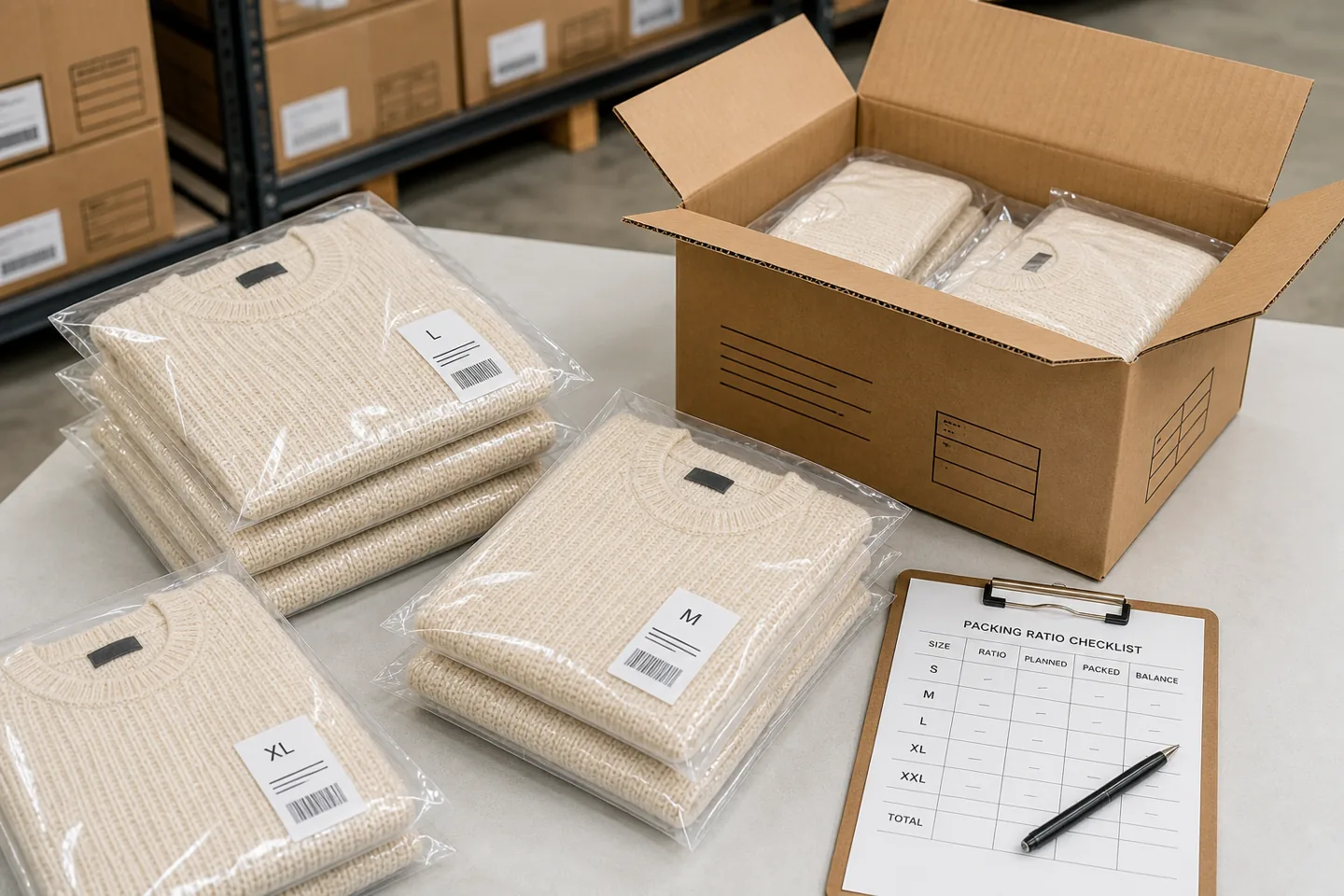
Control assortment and carton marks
Write whether cartons are solid by style, color or size, or contain an approved assortment. Provide the units per inner pack and carton, permissible carton weight or dimensions if required, and rules for partial cartons. The packing ratio must reconcile with the purchase order so the warehouse receives the quantity it expects at SKU level.
Carton marks commonly identify purchase order, style, color, size range, quantity, carton number and destination, but the buyer or logistics provider should issue the exact required format. Confirm any retailer routing label, shipping label or advance-shipping data separately. Avoid printing a final address or routing mark from an old order.
Approve a complete packed sample
Before bulk packing, review one representative garment as the customer or warehouse will receive it: all sewn labels attached, hangtag in position, barcode applied, garment folded, individual pack sealed and carton identification visible. Record the approved version with photographs and comments. During final inspection, sample packed units across styles, colors, sizes and cartons rather than checking one convenient top carton.
Yushengda supports customer-nominated third-party inspection. The buyer should provide the approved packaging specification, SKU packing table and acceptance rules to the inspection provider. Requirements for labels, packaging and testing affect quotation and timing, so include them in the RFQ rather than releasing them only after garment approval.
Buyer approval checklist
- Destination markets and responsible compliance reviewer confirmed.
- Every label, tag, sticker and pack listed in a component schedule.
- Fiber, care and origin wording matches the approved garment.
- Artwork, translations, placement and attachment approved.
- Barcode-to-SKU mapping and scan verification defined.
- Folding method and individual packing shown visually.
- Packing ratio reconciles with ordered quantities.
- Carton and routing marks issued by the responsible party.
- A complete packed sample is approved before bulk packing.
Use the custom sweater RFQ checklist and third-party inspection guide, or send your label schedule and packing instructions for a project-specific review.
Compliance references: US FTC textile labeling guidance and EU textile-label overview. These authoritative summaries support the general regulatory context; buyers remain responsible for requirements applicable to their products and markets.