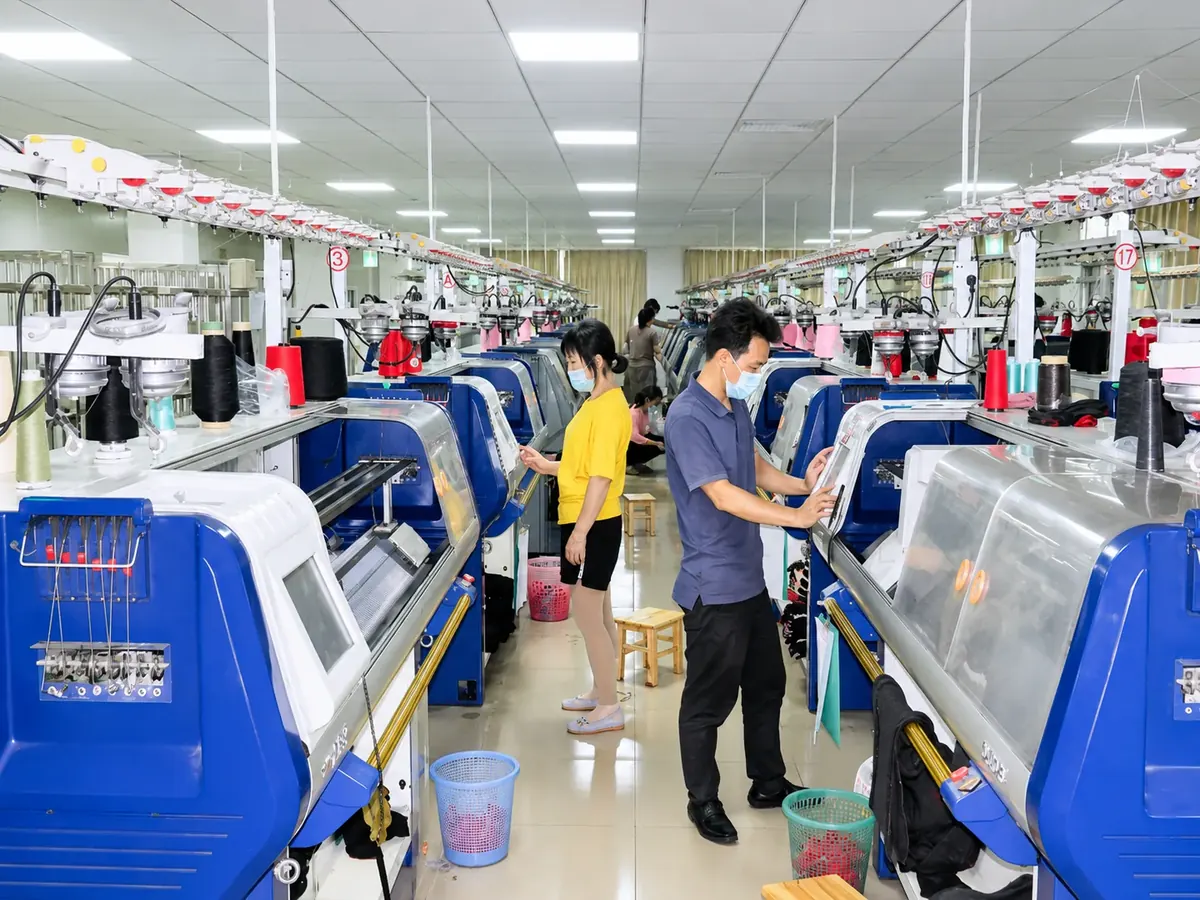
Stitch structure changes sweater cost through more than yarn weight. Gauge, courses, stitch actions, needle transfers, color changes, carrier movement, machine speed, program development, panel shaping, linking, finishing and reject risk can make two similar-weight sweaters require very different production time. Compare quotes using the same yarn, size, stitch map and finish, then ask which operations—not a generic complexity surcharge—drive the difference.
Split cost into material, time and risk
Yarn cost begins with composition, count, ply, number of ends, color route and consumption. Conversion cost includes programming, machine setup, knitting, panel handling, linking or assembly, washing, finishing, inspection and packing. Risk cost reflects sampling, small lots, unstable structures, rework and expected yield.
Ask suppliers to explain the dominant cost drivers without demanding confidential margins. A useful answer might identify high yarn consumption, long machine time, many color fields or intensive linking. A percentage labeled “complexity” without the specified construction cannot be compared.
| Structure factor | Possible cost effect | Evidence to compare |
|---|---|---|
| Density/courses | More yarn and/or machine time | Finished swatch, dimensions and weight |
| Transfers/tucks | Additional knitting actions and risk | Approved stitch map and trial |
| Color fields | Carrier movement, back construction, ends | Face/reverse sample and color map |
| Shaping | Programming, fashioning and panel handling | Panel drawings and size set |
| Assembly | Linking, sewing and alignment work | Seam map and complete garment |
| Finish | Extra process, shrinkage and rework exposure | Production-intended finished sample |
Do not use garment weight as the whole costing model
Finished weight is commercially important, but equal weight does not mean equal knitting time. A plain jersey may convert yarn with relatively simple repeated actions, while a cable, tuck, pointelle, jacquard or intarsia panel can require transfers, multiple systems, carrier positioning or slower stable settings.
Conversely, a heavier simple garment is not automatically more expensive than every lighter complex garment. Compare yarn value and quantity against machine and labor time. Ask whether quoted weight is measured from an approved finished sample or estimated from an early design.
Count structure transitions, not just named stitches
A drawing labeled “cable sweater” is incomplete. Record cable width and repeat, transfer frequency, panel coverage, surrounding stitch, rib transitions, fashioning and whether the cable continues across shaping. A small engineered placement may cost differently from an all-over structure even at the same gauge.
Mixed structures create boundary work and dimensional interactions. Jersey beside rib, tuck, pointelle or cable may shrink, widen or relax differently. Additional sampling and program adjustment are legitimate development tasks when the final measurements and appearance must remain controlled.
Price jacquard and intarsia by the actual artwork
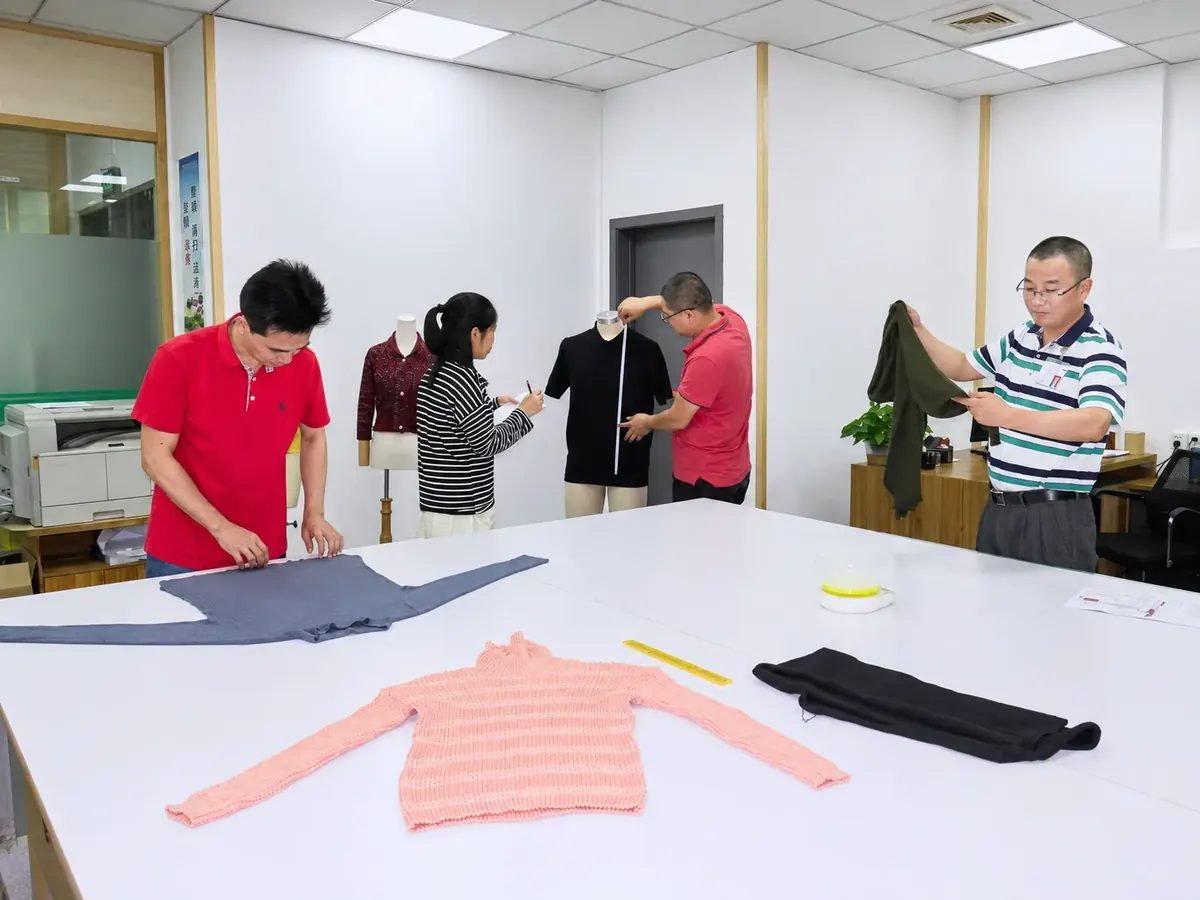
Give the final artwork dimensions, stitch-and-row map, number of colors per row or field, selected construction, reverse appearance, float or join controls, placement and graded-size rule. “Two-color logo” does not show how many carriers, boundaries, rows or back-structure decisions are required.
STOLL's official pattern-software documentation shows that imported images are converted into stitch-based patterns with separate jacquard and intarsia processing choices. SHIMA SEIKI likewise describes digital design support for structure, intarsia and jacquard patterns. These sources demonstrate why artwork conversion is technical work; they do not identify which equipment Yushengda owns.
Include gauge and yarn as one system
Machine gauge alone does not predict price. Yarn count, ends, stitch length or density, structure, panel dimensions and production speed interact. A finer gauge may use less yarn per stitch but contain more needles and courses; a coarse gauge may use expensive or bulky yarn and produce heavier panels.
Request two physical alternatives when a design can be engineered more than one way. Compare finished appearance, hand, opacity, weight, measurements, machine-time direction, yarn use and quality risk. Do not authorize a gauge change only because its unit quote is lower.
Account for shaping and panel efficiency
Fully fashioned shoulders, armholes, necklines, darts, gores and engineered placements require size-specific program logic. The number of panels, symmetry, left/right identity and size range can change setup and handling. A long cardigan, hood or belt adds knitting area even when the body stitch is simple.
Panel yield also matters. Breakage, dropped stitches, unstable edges, visible lines or shade segregation can reduce usable output. Ask how early trials and first-bulk checks will confirm a stable route before assuming perfect yield in the quote.
Map linking, sewing and hand operations
List every shoulder, armhole, sleeve, side seam, neckband, placket, pocket, hood and trim attachment. Define linking, sewing or another method, pattern alignment and inside appearance. A structure that is quick to knit may still require slow loop-by-loop linking or careful motif matching.
Hand-applied trims, embroidery, loose-end handling, tassels, belts and repairs add operations outside machine time. Ask whether these are included and whether sample construction matches the quoted bulk route.
Develop finishing with the knit
Washing, brushing, softening, spray dyeing, tie dyeing, pressing and blocking can change dimensions, surface and reject risk. A structure may need a different program allowance or handling route to reach the same final measurement after finish.
Quote the production-intended finish, trial approvals, color scope and acceptance boundary. A price for an undefined “vintage wash” cannot be compared with one that includes repeated physical approval and lot controls.
Request cost-down options as controlled designs
Ask which visible result must remain and which variables are flexible. Options may include reducing all-over coverage, simplifying a repeat, limiting color fields, sharing yarns across styles, changing an internal back construction, reducing hand operations or selecting another gauge-yarn route.
Every proposal should state the expected effect on face, reverse, hand, weight, fit, performance, MOQ and delivery. Approve a new swatch or sample and revised quote. Cost engineering is a product change, not permission to silently remove operations.
Buyer stitch-cost checklist
- All suppliers quote the same yarn, size, stitch map and finish.
- Yarn value, machine time, labor and risk are separate drivers.
- Weight is measured or clearly identified as estimated.
- Transfers, tucks and structure transitions are visible.
- Jacquard/intarsia artwork and reverse construction are fixed.
- Gauge and yarn are compared as a combined route.
- Shaping, panels and size-specific programming are included.
- Linking, alignment and hand operations are mapped.
- Finishing trials and quality risk are priced.
- Cost-down alternatives receive physical reapproval.
Yushengda develops custom knitwear across 3GG–16GG in wool, cotton, acrylic, viscose, cashmere and blends, subject to the project. Use the quote comparison guide, the gauge selection guide, or send your stitch artwork, yarn direction, sample, quantity and target cost for an RFQ discussion.
Primary references: STOLL, Import pictures, documenting stitch-based image conversion and jacquard/intarsia choices; SHIMA SEIKI, SDS-ONE APEX virtual sampling, describing flat-knit structure, intarsia and jacquard design support. Competitor costing articles were reviewed only for gaps; no prices, percentages, speeds, machine claims, cases, images or wording were reused.