Control any sweater change after approval through a written request that identifies the original requirement, proposed revision, reason, affected quantities and production status. Assess consequences for appearance, fit, hand, weight, performance, claims, cost and delivery; require the evidence appropriate to that risk; obtain authorization before use; then update every controlling record and segregate affected material. A chat message or visually similar substitute is not adequate change approval.

Why approval does not make later changes harmless
An approved sample represents a connected system: yarn, count, ply, gauge, stitch, measurements, trims and finishing route. Changing one input can alter several outputs. A nominally equivalent yarn may knit at a different density, produce another hand or shade, respond differently to washing and change garment weight. A revised finish can move measurements or color even when construction is unchanged.
ISO guidance on documented information notes that review results, authorization and necessary actions for production changes should be retained. For a buyer, the practical lesson is simple: record what changed, who evaluated it, who approved it and what must happen next. The project contract and buyer manual determine the actual authority.
Open one change request, not parallel conversations
Give every request an ID and record PO, style, color, size, operation, original specification revision, proposed revision, reason, requester and date. State whether the driver is availability, quality, compliance, capacity, cost, design or schedule. Identify material already ordered, panels already knitted, garments already finished and cartons already packed.
| Change | Key impact questions | Likely evidence |
|---|---|---|
| Yarn source/count/ply | Claim, gauge, hand, weight, shade, care | Identity record, knit-down, test or garment sample |
| Stitch or gauge | Appearance, dimensions, consumption, machine route | Panel and measured finished sample |
| Wash or specialty finish | Shrinkage, shade, hand, surface, odor | Finished trial and relevant tests |
| Trim or label | Function, artwork, claim, safety, attachment | Component approval and attachment trial |
| Packaging | Protection, presentation, barcode, receiver rules | Packing mock-up or transit check |
| Schedule/route | Quality gates, subcontracting, inspection, ship date | Revised timeline and responsibility map |
Classify the risk before choosing evidence
Do not call a change “minor” only because it is cheap or invisible. Classify its possible impact on product identity and legal claims, safety, performance, customer-facing appearance, measurements and fit, durability, care, packaging accuracy and delivery. A spelling change on a required label may be more consequential than a visible internal construction adjustment.
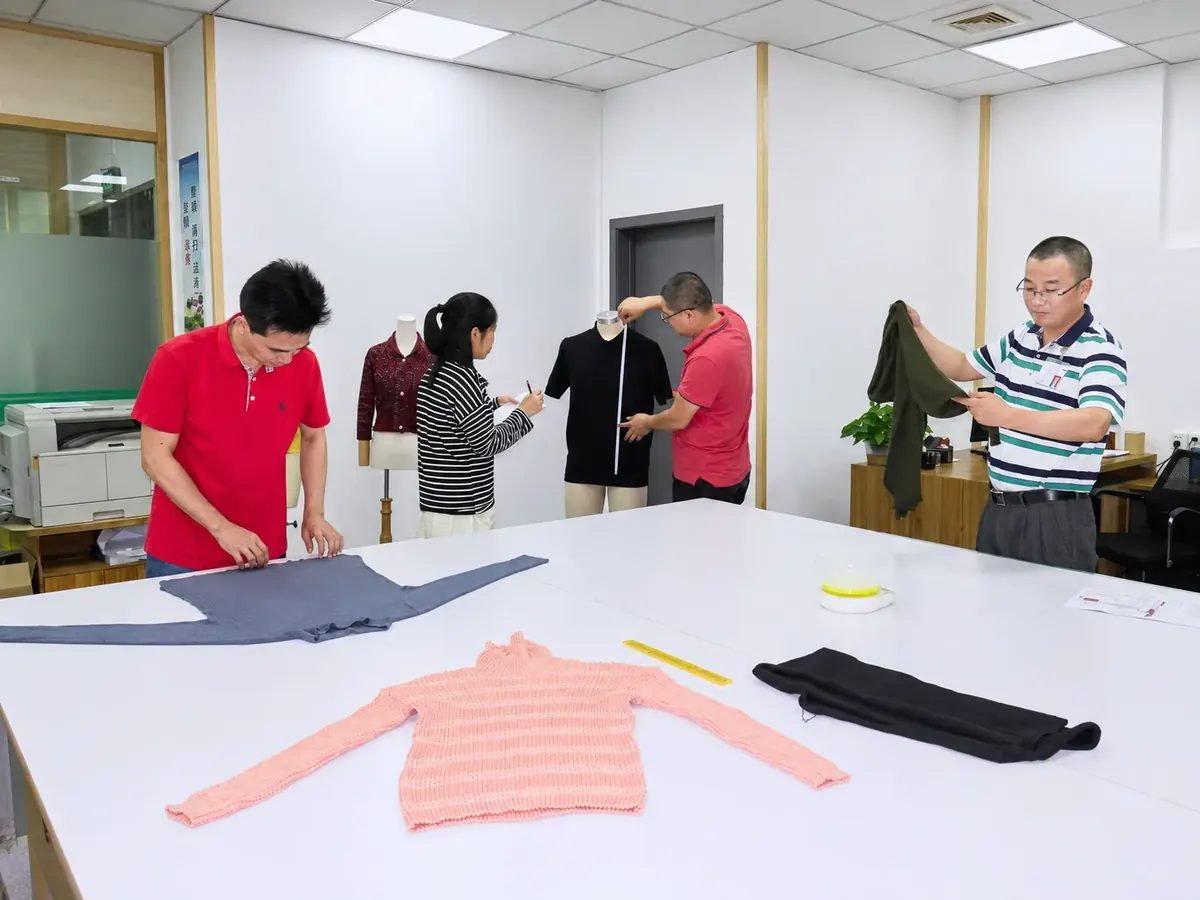
Use the lowest level of evidence that can answer the actual risk, but no lower. A document review may close an administrative correction. A physical component or knit-down may support a limited material decision. A complete finished garment is appropriate when interactions with fit, wash, hand or appearance must be seen. Relevant testing may need repetition when the tested construction or material changes.
Define approval authority and production holds
The factory can propose a solution and supply evidence, but it should not assume buyer approval. Name who may approve product, commercial, compliance and delivery consequences. If several functions are affected, record each required decision. Silence, payment or acceptance of an unrelated update should not be interpreted as approval.
State the hold boundary: buying substitute yarn, knitting panels, linking, finishing, packing or shipping. Work that is technically independent may continue only when separately authorized. Mark and segregate affected lots so an unapproved trial cannot enter accepted production.
Calculate the full scope of impact
Trace the change forward and backward. Which colors, sizes, batches, machines, subcontractors and cartons are affected? Does the quotation, BOM, tech pack, care label, fiber claim, test plan, approved sample, inspection checklist or delivery calendar need revision? Does material already produced require reinspection, rework, replacement or a documented concession?
For a late discovery, establish the last known conforming point and identify all output since then. Photos of one acceptable garment do not define the population. Quantities and lot identities allow the buyer and inspector to decide whether sorting, focused checks or broader reinspection are needed.
Close the change across every controlling record
Approval is not complete until revised records reach the people doing and checking the work. Update the revision register, BOM, technical instructions, sample status, test and inspection plans, quote or PO where applicable, and time-and-action calendar. Remove obsolete copies from production areas and clearly mark retained historical references as superseded.
The closure record should include submitted evidence, reviewer comments, final disposition, authorized scope, effective lot or date and verification of implementation. If rejected, record how trial materials and output are quarantined or disposed of. If conditionally approved, state the quantity and expiry; do not let a one-lot exception become the next order's standard.
Buyer change-control checklist
- One numbered request identifies original and proposed requirements.
- Affected styles, colors, sizes, lots and production stages are quantified.
- Product, compliance, cost and timing effects are assessed separately.
- Evidence matches the consequence of the change.
- Approval authority and production hold points are explicit.
- Trial and approved production remain physically traceable.
- Already-made goods receive a documented disposition.
- All source records are revised and obsolete copies withdrawn.
- Implementation is verified at the first affected output.
- Conditional approval has a defined scope and end point.
Yushengda develops wool, cotton, acrylic, viscose, cashmere and blended knitwear across 3GG–16GG, subject to project requirements, and supports customer-nominated third-party inspection. Pair this framework with the pre-production meeting guide, sweater BOM guide and sealed-sample guide, or send the original specification, proposed change, affected quantity and deadline for a feasibility discussion.
Primary reference: International Organization for Standardization, Guidance on the Requirements for Documented Information of ISO 9001:2015, including records of production-change review, authorization and necessary actions. This is quality-management guidance, not product-specific legal advice. Competitor articles were used only to identify buyer questions; their wording, figures, images, cases and claims were not reused.