A sealed sweater sample should be one uniquely identified physical garment linked to the final tech pack, measurement chart, bill of materials, yarn and color references, artwork files, test decisions and approved deviations. Before bulk starts, both buyer and factory should confirm what the sample proves, what it does not prove, who holds each reference and which written document wins if the sample and specification conflict.
Define the sample's authority
Write the sample stage, style number, color, size, sample number, revision, date and approval status on a durable tag or controlled record. “Final sample” is ambiguous: it may mean a fit sample, size-set sample, pre-production sample or a garment taken from live production. Name the stage and the decisions it closes.
A pre-production sample should normally represent the intended material, construction and finish, but projects vary. J.Crew's public vendor quality manual, for example, requires a sweater pre-production sample before production and describes it as made to the correct quality standards for approval. That is a buyer-specific requirement, not a universal rule for every order; define the equivalent requirement in your purchase documents.
| Control field | Record | Reason |
|---|---|---|
| Identity | Style, size, color, sample ID and date | Prevents the wrong garment becoming the reference |
| Revision | Tech pack, BOM, artwork and program revisions | Links the sample to the approved instructions |
| Status | Approve, revise/resample or reject | Removes ambiguous production authority |
| Exceptions | Every known departure and closing evidence | Stops an accepted defect becoming the bulk standard |
| Custody | Holder, location, seal and duplicate record | Keeps the benchmark available for production and inspection |
Reconcile the sample with the final specification
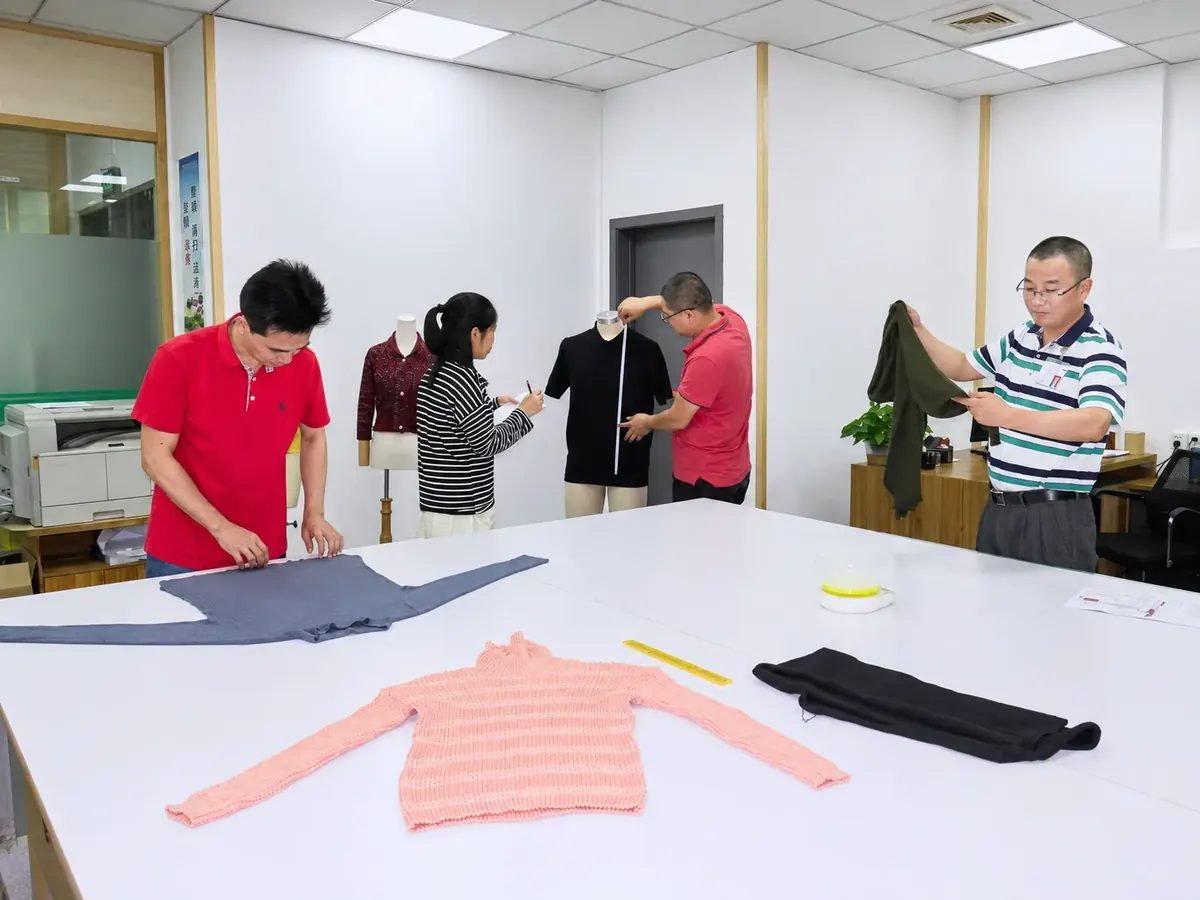
Compare the physical garment against the latest measurement chart, points of measure and tolerances; yarn composition and reference; gauge and stitch structure; garment weight where controlled; color standard; trims; artwork; labels; finishing; care route and packing requirements. Record actual sample measurements instead of signing only a photograph.
If the sample differs from the document, resolve the conflict before production. Either revise the document to match an intentionally accepted result, or make and approve corrected evidence. Never leave an email saying “sample approved” beside a tech pack that still requires another neckline, button, label or wash.
Ban “approved with comments” from open-ended use
Comments fall into two categories. A non-product administrative note may be closed without another garment. A change affecting fit, yarn, gauge, stitch, color, artwork, trim, construction, finish, performance or labeling usually needs defined evidence and may require resampling. Assign each comment an owner, due date and closure record.
Do not use the approved sample itself as evidence for a feature it does not contain. If bulk will use a different production color or label, identify the separate approved yarn standard, lab dip, strike-off, label sample or packaging proof. The master record should show how those pieces combine into the production standard.

Keep fact, tolerance and visual judgment separate
Some requirements are factual: correct fiber wording, artwork revision or button count. Some are measured against a tolerance: chest width or placement. Others require a visual comparison: hand feel, stitch definition or acceptable minor appearance variation. Label each category so inspectors do not invent a number for a visual property or excuse a wrong component as subjective.
A sealed sample can demonstrate workmanship and appearance, but it cannot override legal requirements, test methods, safety rules or the agreed measurement specification. It also cannot prove lot-wide consistency. Yarn shade, dimensions and workmanship still require bulk controls and representative inspection.
Control the physical sample and its digital twin
Use tamper-evident identification where appropriate and photograph the front, back, inside, labels, distinguishing details and approval tag under consistent conditions. Record who approved it, where the buyer and factory references are stored, and whether a duplicate is genuinely equivalent. Avoid writing on a part of the garment that could transfer or damage it.
ISO's guidance on documented information for ISO 9001:2015 explains that documented information may exist in any medium and must be controlled under the applicable requirements. Applied here, the practical lesson is to control access, retrieval, preservation, revision and obsolete versions across both the garment and its linked digital files—not to claim that sealing a sample creates ISO certification.
Hold a pre-production alignment meeting
Before yarn is committed or bulk knitting begins, review the sealed reference with merchandising, programming, knitting, linking, washing or finishing, trimming, quality and packing functions relevant to the style. Confirm the current files, special risks, approved exceptions, checkpoints and escalation owner. Photograph or sign the meeting reference so later teams can identify it.
For complex jacquard, spray dye, garment wash, embroidery or mixed structures, identify which variation is controllable and which exact characteristics are non-negotiable. Set early checks at the operation where a mistake can still be corrected rather than relying only on finished-carton inspection.
Verify first bulk without redefining the standard
Compare first bulk panels or garments with the sealed sample and written criteria before full output. Check identity, yarn and lot, program, measurements, construction, artwork, color, hand, finish, trims and labels. If first bulk reveals a necessary change, stop and issue a controlled revision; do not quietly replace the sealed sample.
A top-of-production sample is evidence taken from the live process. It answers whether production is following the standard, not whether the standard can be rewritten after production starts. Trace the result to machine or line, shift, size, color, yarn lot and finishing batch where those factors matter.
Make the reference available at final inspection
Give the inspector the current sealed sample, tech pack, measurement chart, approved color and component references, packing instructions, defect classification and any authorized deviations. Confirm that obsolete samples and files are marked or removed from the decision path.
If the sealed sample contains a known imperfection, state explicitly whether it is accepted only for that sample or becomes the bulk acceptance boundary. Never assume an inspector will infer the difference. Final acceptance should follow the purchase agreement, applicable requirements and inspection plan, not memory.
Buyer sealed-sample checklist
- The physical garment has a unique style, size, color and sample ID.
- Its approval stage and authority are explicit.
- Tech pack, BOM, artwork and measurement revisions are linked.
- Actual measurements and physical details are reconciled.
- Every deviation has a written disposition and closure.
- Separate color, trim, label or packaging evidence is indexed.
- Buyer and factory reference custody is recorded.
- Obsolete samples and files cannot be mistaken for current ones.
- First bulk is compared without silently changing the standard.
- The complete reference set reaches final inspection.
Yushengda develops custom knitwear in wool, cotton, acrylic, viscose, cashmere and blends across 3GG–16GG, subject to the project. Use the sample review checklist, the AQL inspection-plan guide, or send your tech pack, sample status, yarn, size range and quantity for an RFQ discussion.
Primary references: J.Crew Imports, Vendor Quality Management manual, including its sweater pre-production sample requirement; ISO, Guidance on documented information under ISO 9001:2015. Buyer and competitor guides were reviewed only to identify coverage gaps; no proprietary tolerances, claims, cases, images or wording were reused.