Write sweater fit sample comments as executable instructions, not impressions. Identify the exact sample and revision, record actual versus target measurements, connect each observation to a numbered photo, state the required correction and priority, and finish with one approval status. Keep fit, construction, yarn, color and finishing decisions separate so the supplier knows what to change, what remains open and whether another sample is required.
Start with the sample identity and decision
Put the style code, sample stage, sample number, revision, color, size, date received and date reviewed at the top of one controlled comment sheet. State whether the sample uses production-intended yarn, trims and finish. If a substitute is present, list which judgments remain provisional.
Then choose one status: approved, approved subject to listed corrections, revised sample required, or rejected with a new brief required. Add partial decisions where necessary, such as “fit approved; color and hand pending.” Do not bury the status inside a long email.
Convert every observation into a closed-loop instruction
A useful comment contains five parts: location, observed result, evidence, requested action and verification. “Sleeve feels long” leaves the patternmaker guessing. A controlled note says which sleeve point was measured, the actual result, the current specification and tolerance, the new target or requested change, and what must be checked on the next sample.
| Field | Useful entry | Avoid |
|---|---|---|
| Location | Left front neckline, photo 04 | Top looks wrong |
| Evidence | Actual POM, spec, difference and fit photo | Looks about 2 cm off |
| Action | Requested result or problem to solve | Please improve |
| Priority | Must correct, discuss, or future option | One undifferentiated list |
| Closure | Verify in revision 2 or update record only | No next step |
Separate the observation from the proposed technical solution. The buyer can define the desired fit and target measurement, while the supplier may need to advise whether shaping, stitch tension, linking, wash or another construction variable is responsible. If the cause is uncertain, request a root-cause response before prescribing a pattern change.
Measure by the agreed point and method
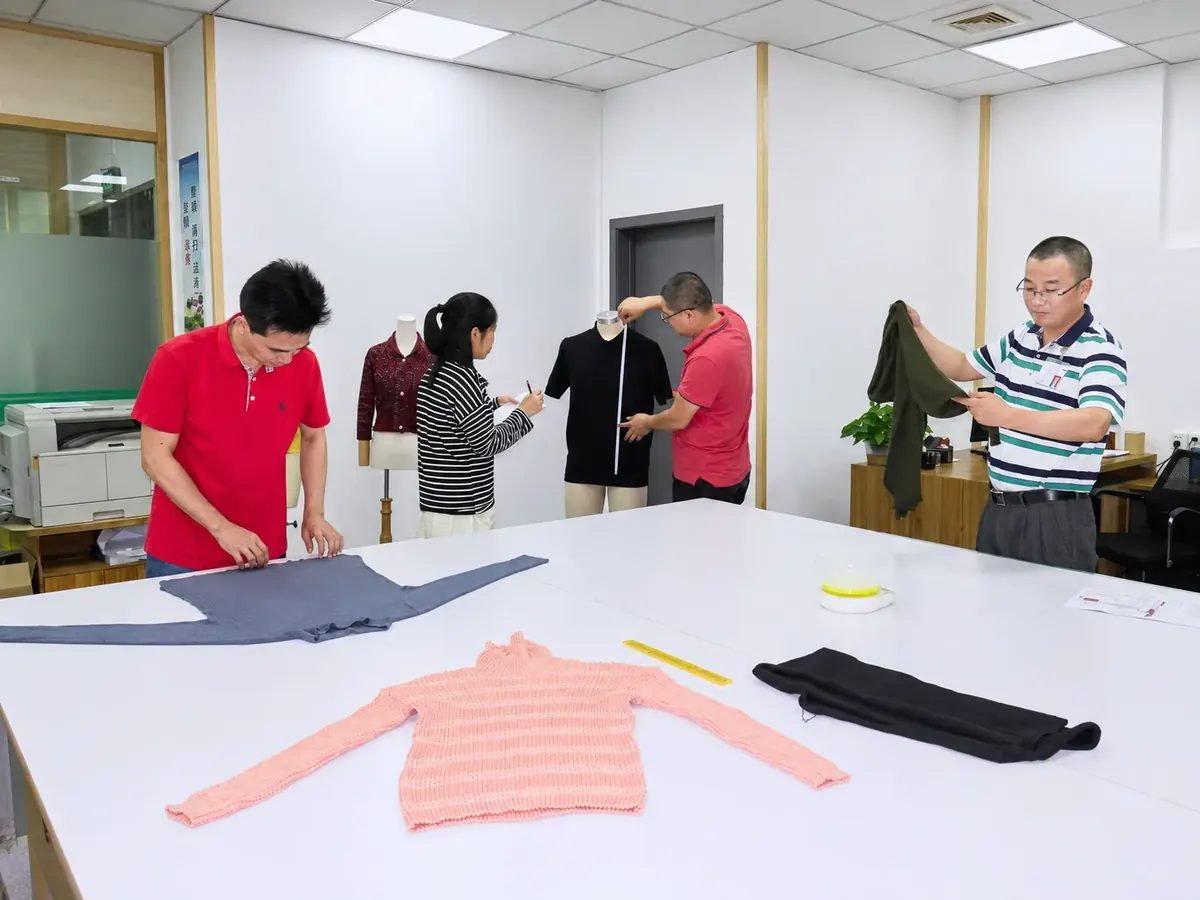
Use the latest measurement chart and point-of-measure diagrams. Record the garment's conditioning state, how it was laid out, whether rib or stretch areas were relaxed, and the units used. Compare actual, specification, tolerance and requested revision in adjacent columns. Do not silently change the specification to make an out-of-tolerance sample pass.
Fit and measurement are related but not identical. A chest can meet the flat measurement while the shoulder, armhole or fabric behavior still restricts movement. Conversely, a visually preferred silhouette may be a design change rather than a correction. Label design changes because they can affect grading, yarn consumption, price and schedule.

Use photos that point to numbered comments
Capture full front, back and side views before detail images. Keep camera angle, garment position and fitting conditions consistent where practical. Add arrows or circles without covering the problem, and label each image with the style, revision and comment number. One close-up should still have a wider context image.
Do not rely on screen color for shade approval or on photos alone for hand feel, weight, recovery and subtle surface effects. Mark those decisions as pending a physical reference or agreed evaluation method. Photos are evidence of what was visible under stated conditions, not proof of every product characteristic.
Separate comments by decision owner
Group rows into fit and measurement; stitch and construction; yarn and hand; color and finish; trims and labels; and packing where relevant. This prevents a fit approval from accidentally approving temporary yarn or an unfinished label. Use one row per issue so the next reviewer can close it independently.
Assign a priority and response owner. “Must correct before approval” blocks the next gate. “Supplier to advise” requires feasibility, cost or timing feedback. “Future development” should not enter the current production specification. If one change affects another area—such as body length moving pocket or artwork placement—list the dependency.
Control revisions after the meeting
Consolidate internal feedback before sending it. Conflicting comments from email, chat and marked PDFs create multiple unofficial versions. Issue one dated file, retain the prior revision, and ask the supplier to acknowledge each row as understood, queried or completed. Update the tech pack and measurement chart after an agreed change instead of leaving the decision only in correspondence.
ISO guidance on documented information identifies design and development changes, their review, authorization and necessary actions as records an organization may need to retain. This does not require a particular sweater comment-sheet format; it supports the practical principle that the approved change and its authority should remain traceable.
Buyer fit-comment checklist
- The exact style, stage, size, color and revision are identified.
- Production-intended and substitute elements are distinguished.
- One explicit approval or resample status appears at the top.
- Each issue occupies one numbered row.
- Actual, specification, tolerance and requested result are separate.
- Photos link directly to comments and include context views.
- Fit, construction, yarn, color, finish and trim decisions are separated.
- Priorities, dependencies, owners and response dates are visible.
- Agreed changes update the controlled tech pack and spec.
- The next sample or record review has defined closure evidence.
Yushengda develops custom knitwear in wool, cotton, acrylic, viscose, cashmere and blends across 3GG–16GG, subject to the project. Use the measurement-tolerance guide, change-control guide and sealed-sample guide, or send your latest tech pack, sample identity and consolidated comments for a development review.
Primary reference: International Organization for Standardization, Guidance on documented information for ISO 9001:2015, including records of design-development review, authorization and change actions. Competitor articles were reviewed only to identify common coverage and gaps; no wording, examples, claims, images or templates were reused.