Approve cuff and hem rib recovery on the finished sweater after the intended wash and finish, not from a loose rib swatch or a single stretched measurement. Define the relaxed opening, how far the rib is extended, how long it is held, how it is released and what must recover. Review the garment on a flat surface and in its intended wearing position, then repeat the checks across sizes, colors and production lots. Recovery is a style-specific performance decision, not a universal percentage.
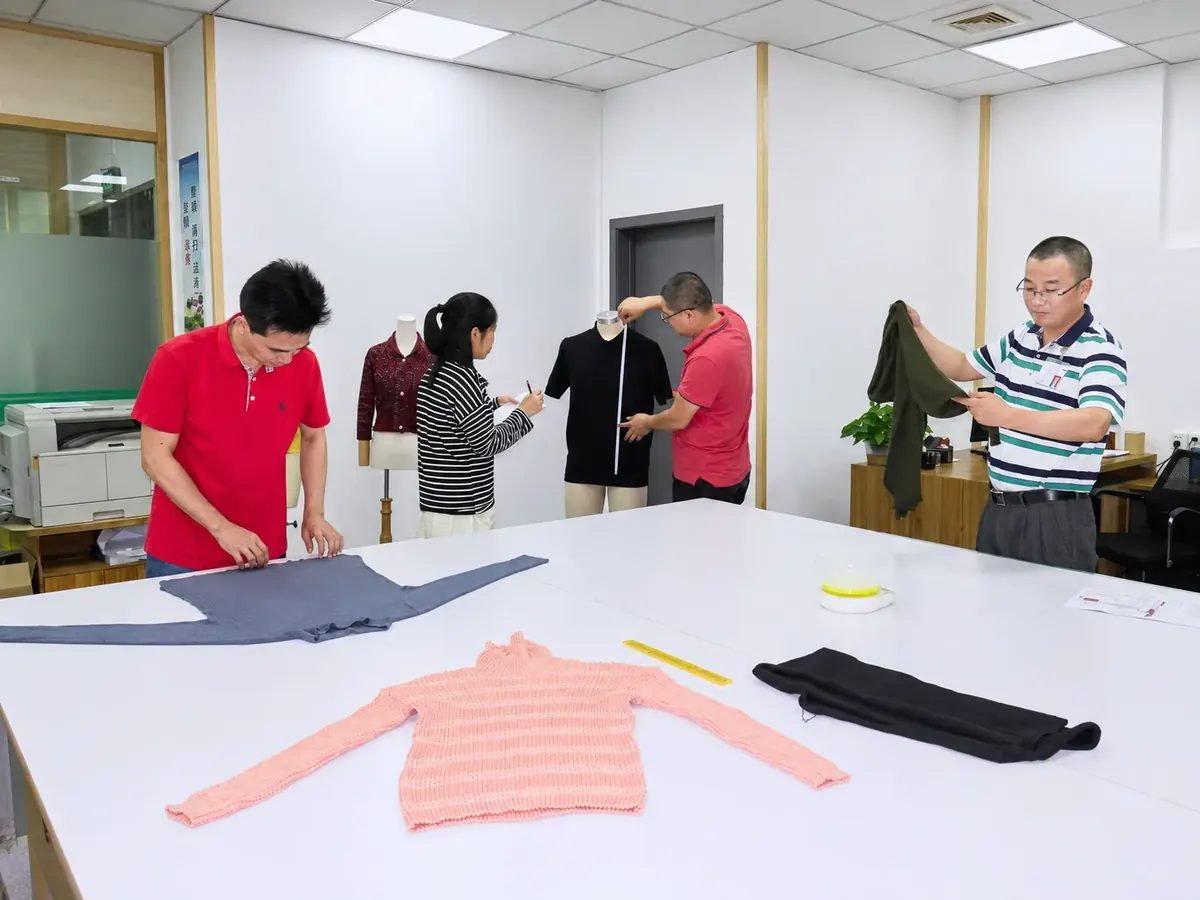
Why cuffs and hems change the buyer's fit decision
Rib sections are designed to contract, stretch and return while the body of a sweater behaves differently. A cuff that is too tight can restrict movement or feel difficult to dress. A cuff that relaxes too far can slide over the hand and make the sleeve look long. A hem that grows after wear can change the silhouette, while an overly strong rib can pull the body into unwanted gathering.
The visible result depends on yarn composition, yarn count and twist, rib structure, stitch density, course direction, linking, finishing, moisture, pressure and the time under stress. A wool rib, cotton rib, acrylic blend and cashmere blend may not respond alike. Even two styles using the same yarn can need different rib specifications because their opening, depth, weight and intended fit differ.
Keep three questions separate: does the rib look correct when relaxed, can it extend to the intended body or hand position, and does it recover after that extension? A sample can pass one question and fail another. A good-looking cuff on a table does not prove it will stay in position during wear or after care.
Write the rib requirement in measurable terms
Put the base size and size range on the tech pack. For each cuff and hem, identify relaxed opening, rib depth, attachment seam, stitch or rib structure, yarn direction and the point-of-measure method. State whether the measurement is taken immediately after finishing, after a defined conditioning period or after another agreed interval. “Standard rib” leaves too much room for interpretation.
Define the intended extension: for example, the hand passage or body circumference the garment must accommodate. Record the direction of pull, the extension distance or circumference, the hold duration, the release position and the observation time before measurement. If a test laboratory is involved, name the method and specimen. Do not copy a number from a different fabric or promise a result before the actual garment is evaluated.
| Control point | Buyer release evidence | Risk if unclear |
|---|---|---|
| Relaxed opening | Defined POM, conditioning state and approved reference | Cuff or hem appears too tight or too loose |
| Rib depth and structure | Stitch map, finished depth and construction detail | Uneven contraction or changed silhouette |
| Extension | Specified direction, distance/circumference and hold | Different operators create incomparable results |
| Recovery | Release method, wait time and pass/fail observation | Temporary stretch is mistaken for permanent growth |
| Care route | Washed/finished sample reviewed under intended instructions | Rib changes after shipment or first wash |
| Size set | Small, base and large sizes checked where relevant | One approved size hides grading problems |
Use fabric methods as evidence, not as an automatic garment limit
ASTM D2594/D2594M-21 covers stretch properties of knitted fabrics having low power and describes measuring stretch under a known load and fabric growth after prolonged extension. Its scope explains why stretch, growth and recovery are useful when selecting material for apparel. It also cautions that the method is not recommended by itself for acceptance testing of commercial shipment because between-laboratory precision can be poor.
That boundary matters for a sweater buyer. A fabric-strip result can compare materials or support development, but it does not automatically establish the acceptable cuff opening, hem growth or whole-garment fit. If a laboratory method is specified, keep its sample construction, conditioning and reporting separate from the garment's visual and functional approval. A test report is evidence for a defined method; it is not permission to change the style's acceptance rule without agreement.
Approve the complete sweater after finishing
Use the production-intent yarn, gauge, rib, body, seam, wash, dye, spray, brushing, steaming and drying route. Measure the cuff and hem relaxed, then inspect their transition into the body. Look for rippling, flare, excessive draw-in, uneven left-right opening, twisted linking, broken ribs, seam puckering and a rib depth that no longer matches the approved sample.
Extend the cuff in the way a wearer would put on the sweater. Check whether the hand passage is practical without forcing the seam and whether the cuff returns to its intended position. For a hem, review the garment on the intended body form or wearer after sitting, reaching and normal movement where appropriate. Inspect the sweater immediately after release and again after the defined observation time; the interval is part of the test record.
Woolmark care guidance recommends following the actual care claim and flat drying wool sweaters where the label requires it. That is a consumer-care instruction, not a substitute for product development. The buyer should test and approve the care route that will be printed on the label, because a different drying or pressing step can alter rib shape, dimensions and appearance.

Check grading and materials across the size set
Rib dimensions should be reviewed alongside body measurements and intended ease. A cuff that is proportionally unchanged across sizes may bind on a larger size or look loose on a smaller one. A hem rib that scales too quickly can create a gathered look, while one that does not scale may lose the intended hold. Review the relationship between rib opening, rib depth, sleeve or body circumference and seam construction.
Sample across color and material lots when the project includes contrast ribs, mélange yarn, specialty finishing or substitutions. Color is not only visual: a different yarn or dye route can change friction, hand and recovery. Do not merge an apparently similar rib with the body without recording the yarn and construction identity.
Define bulk checkpoints and hold rules
At first bulk, inspect the rib before linking where possible and again on finished garments. Verify relaxed dimensions, symmetry, seam integrity, body balance, extension behavior and recovery. Sample across operators, machines, colors, sizes and production timing. Retain measured records and photographs tied to garment identity; a photograph alone cannot prove recovery or lot-wide conformity.
If results are outside the approved range, hold the affected group and compare yarn lot, stitch settings, rib programming, attachment tension, finishing batch, moisture condition and measurement setup. Trial a correction on a controlled subset. Do not tighten, re-steam or rewash the full order simply to make a measurement look better; those interventions can change hand, shade, dimensions and evidence.
Buyer cuff-and-hem release checklist
- Relaxed opening, depth and point-of-measure are defined.
- Rib structure, yarn and attachment route are released.
- Extension direction, amount, hold and release are written.
- Recovery observation time and pass/fail language are agreed.
- Finished garment is reviewed after the intended care/finish route.
- Cuff hand passage and hem body balance are checked in realistic use.
- Small, base and large sizes are reviewed where grading changes behavior.
- Contrast colors, yarn lots and substitutions are traceable.
- Fabric test evidence is kept separate from garment acceptance.
- First bulk and final inspection include rib appearance and recovery.
Yushengda develops custom knitwear in wool, cotton, acrylic, viscose, cashmere and blended yarns across 3GG–16GG, subject to project development. Cuff and hem rib specifications, finishing route and acceptance criteria must be approved on the actual style. Use the neckline recovery guide, size-set guide and post-wash appearance guide, or send the sweater tech pack, rib reference, size chart and care route for project review.
Primary references: ASTM, D2594/D2594M-21 Standard Test Method for Stretch Properties of Knitted Fabrics Having Low Power, for the defined scope and limitations of fabric stretch/growth measurement; and The Woolmark Company, Sweater Care Guide, for care and flat-drying guidance. Competitor content was reviewed only for buyer questions and coverage gaps; no wording, figures, images, cases or factory claims were reused.