Approve custom sweater size grading by defining the target wearer and market, separating body measurements from finished-garment measurements, writing a grade rule for every point of measure, and reviewing physical risk sizes after the intended finish. A size M sample cannot prove that XS neck openings, XL armholes, sleeve lengths, ribs or motif placement will remain proportional and wearable.
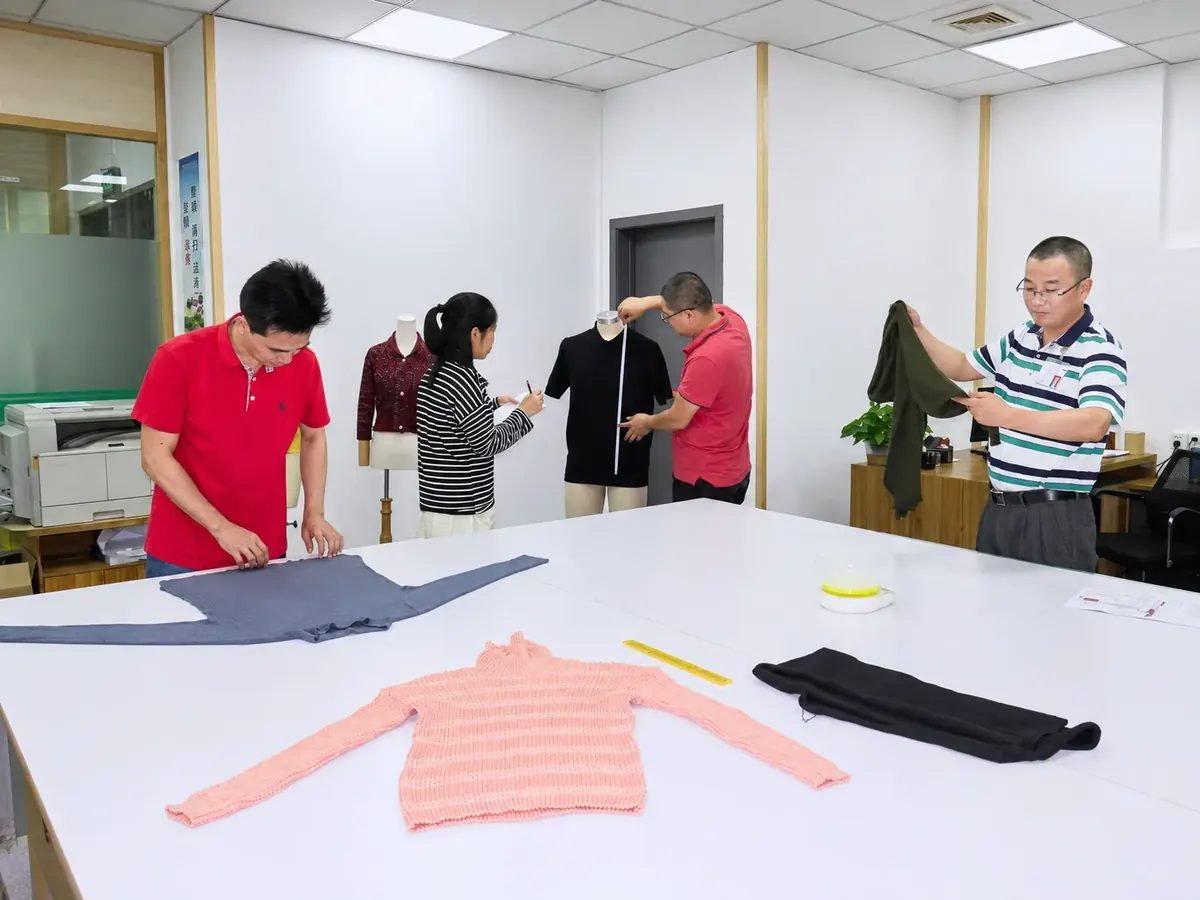
Define the wearer before assigning size letters
XS, M and XL are labels, not universal body dimensions. Identify sales market, product category, intended gender or fit profile, age group and wearer data behind the range. Record the base size and the body dimensions used to select it. Do not ask a supplier to “use European sizing” or “make a standard US medium” without a controlled chart.
ISO 8559-1:2017 describes anthropometric measurements used to build size and shape profiles for selected population segments. ASTM D5585-21 provides body-measurement tables for adult female misses figure types in sizes 00–20. These resources can support a sizing strategy for their stated scope, but neither automatically supplies the finished measurements, style ease or grading of a specific sweater.
Separate body dimensions, garment POMs and ease
A body chest girth is not the same as a flat half-chest measurement on a sweater. The difference between the intended body and finished garment creates ease, which may be positive for a relaxed fit or negative for a stretch-dependent close fit. Define ease by area and size rather than adding one vague “oversized” instruction.
| Layer | Example | Approval question |
|---|---|---|
| Body data | Chest girth for the target wearer | Who is the size intended to fit? |
| Garment POM | Flat half chest at a named location | How is the finished sweater measured? |
| Ease | Difference between body and garment circumference | What silhouette and movement are intended? |
| Tolerance | Allowed production variation at that POM | When is one unit nonconforming? |
| Grade rule | Change from one size to the next | How does fit progress across the range? |
Do not confuse tolerance with grading. A tolerance controls production variation around one target; a grade increment deliberately changes the target between sizes. Using a wide tolerance to hide an incomplete grade allows overlapping sizes and inconsistent fit.
Write a grade rule for every relevant measurement
List all sizes in columns and every point of measure in rows. Define the measurement method with a diagram or annotated photograph, including whether ribs are relaxed, stretched or excluded. Enter actual target values rather than asking the factory to calculate unspecified sizes from the base sample.
Chest, hem, body length, shoulder, armhole depth, bicep, sleeve length, cuff, neckline and collar do not have to change at one rate. A drop-shoulder silhouette grades differently from a set-in sleeve because shoulder growth and sleeve length interact. A cardigan must also preserve placket length, button spacing and pocket position.
Grade the knitted construction, not only the tape measurement
Flat-knit panels are shaped through programmed needles, stitches, courses, transfers and fashioning. The factory may need to change stitch counts and course counts to reach a new finished size. Rounding is unavoidable when the requested increment does not map exactly to the approved construction, so the final target and tolerance must remain commercially workable.
Cables, jacquard repeats, intarsia artwork and engineered stripes require a visual grade decision. Buyers should state whether a motif keeps one physical size, grows by size, remains centered or changes repeat count. Simply widening side areas can distort balance; scaling artwork without approval can change brand appearance.
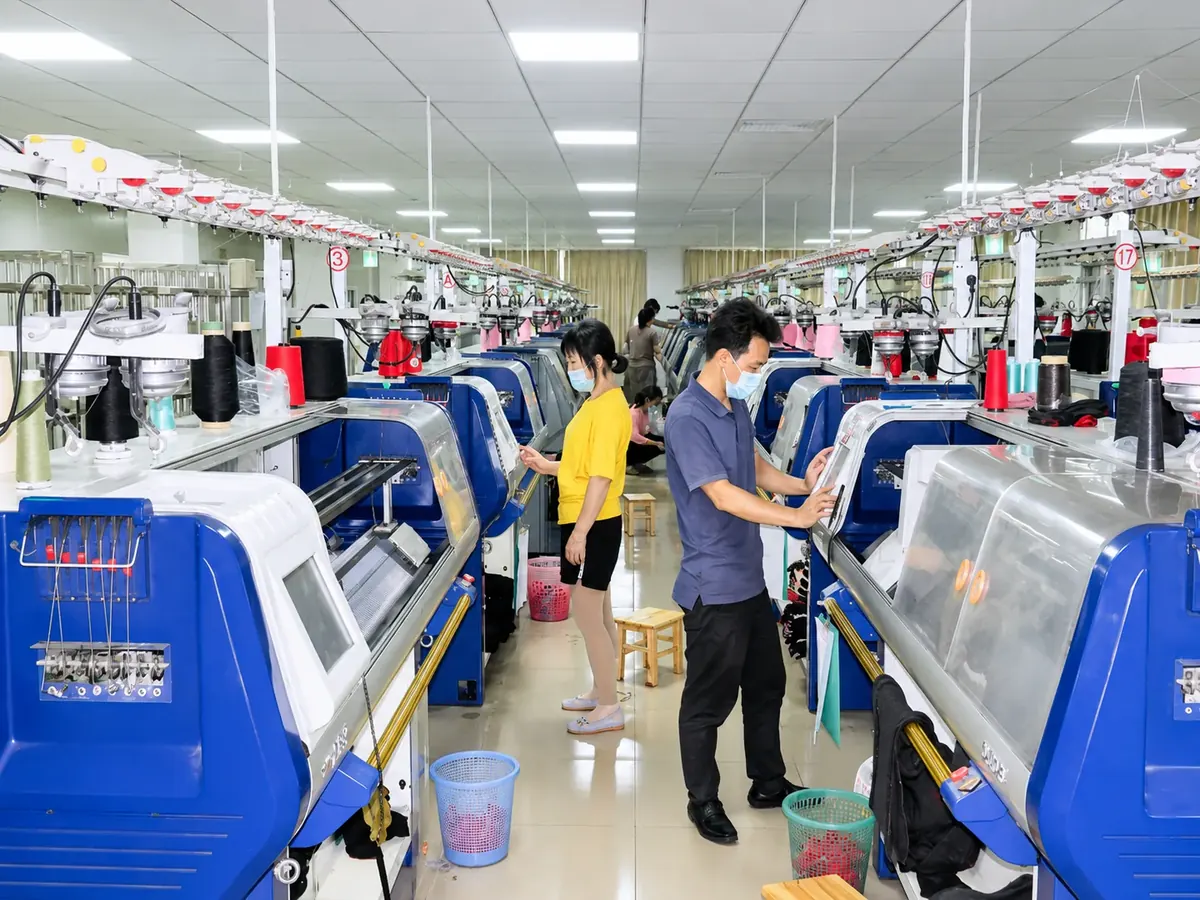
Include ribs, openings and movement checks
A larger body does not automatically mean every rib should increase proportionally. Check relaxed hem and cuff measurements, stretch and recovery, neckline appearance and functional head passage. On close necks, the smallest size can look correct yet fail dressing; on large sizes, an unchanged neck can appear visually underscaled.
Fit each selected size on an appropriate fit model or agreed form. Review shoulder position, arm lift, sleeve pitch, underarm comfort, body balance, hem sweep and garment length. Photograph the same front, side and back views and record the model’s relevant body measurements rather than relying on comments such as “XL feels tight.”
Approve size-set samples after production finishing
Select physical sizes according to risk. At minimum, the smallest and largest sizes expose range-end problems; the base size confirms continuity with the approved fit. For broad or extended ranges, review additional breakpoint sizes rather than assuming one grade rule works through the entire population.
Use the intended yarn, gauge, stitch structure and finishing route. Washing, steaming, brushing and specialty finishing can affect sizes differently because panel dimensions and structures change across the range. Condition samples under the agreed procedure, measure every POM and compare both numeric results and worn proportion.
Control revisions without breaking the range
When one size changes, assess downstream effects. Increasing XL bicep may require armhole, sleeve cap or linking changes. Shortening XS body length can alter pocket or motif placement. Issue one versioned size chart that shows previous value, new value, reason, date and approval status.
Separate “approved,” “approved with production correction” and “revised sample required.” If a comment changes fit, construction, yarn or grade logic, request evidence before bulk rather than approving casually in chat. Keep signed size-set measurements, fit photos and the final chart with the production file.
Buyer checklist for size-set approval
- Target population, market and size labels are defined.
- Body dimensions and garment POMs are clearly separated.
- Ease, grade and tolerance are not treated as synonyms.
- Every POM has targets across the full size range.
- Measurement diagrams define exact locations and handling.
- Shoulder, armhole and sleeve grades work as a system.
- Ribs, openings, trims and motif placement have grade rules.
- Smallest, largest and relevant breakpoint sizes are sampled.
- Samples use intended construction and final finishing.
- Fit, measurements and revision status are retained in writing.
Yushengda develops custom knitwear in wool, cotton, acrylic, viscose, cashmere and blends across 3GG–16GG, subject to the project. Use the measurement tolerance guide, the sample approval checklist, or send your size chart, target market, fit reference and yarn direction for an RFQ discussion.
Authoritative references: ISO 8559-1:2017, confirmed current in 2026, for anthropometric definitions used in clothing development; and ASTM D5585-21 for adult female misses body measurements within its stated population and size scope. Neither source is a universal finished-garment grade chart.