To attach a hangtag to a custom sweater without damaging the knit, specify the attachment point and method on the finished sample before bulk packing. Prefer an existing sewn label, seam allowance or purpose-built loop when compatible with the design; do not let an operator choose an exposed knit area by habit. Test the actual fastener through attachment, packing, handling and removal, then inspect for pulled yarn, enlarged loops, holes, distortion and marks.

A correct hangtag can still damage the sweater
Buyers often approve paper stock, logo, price, barcode and string color, then leave installation as “standard.” For knitwear, that missing instruction matters. A tagging needle or sharp pin can split yarn, catch a filament, enlarge an open loop or leave a visible hole. A long or heavy tag can swing against a brushed surface, snag a lace stitch or pull on a weak attachment point during packing and retail handling.
Treat the card, string or plastic fastener, joining hardware, attachment point, garment structure and pack as one system. A method that works on a dense rib may be unsuitable for pointelle, loose gauge, brushed yarn or a fine cashmere blend. “Fine-fabric fastener” is a product description, not proof that the finished sweater will be undamaged.
Define the tag's job and receiving rules first
List what the tag must carry: brand message, price, size, SKU, barcode, legal or sustainability information, care prompt or retailer ticket. Confirm which data are controlled by the brand or retailer and which must match the sewn labels and packaging. If a sales channel provides a vendor manual, its current placement, ticketing and barcode rules take priority over a factory default.
For example, Belk's published vendor requirements direct certain hangtags to sewn labels or specified seams and warn that adhesive-backed tickets must remove without damaging merchandise. That does not create one rule for every retailer; it shows why the buyer should supply the applicable manual and approve the exact sweater implementation.
| Decision | Approval evidence | Failure to prevent |
|---|---|---|
| Attachment point | Annotated photo plus stable garment landmark | Random holes, visible asymmetry or blocked labels |
| Fastener system | Physical card, loop/pin/string and tool reference | Snags, breakage or incompatible hardware |
| Finished length | Measured hanging position on the garment | Tag rubbing, tangling or hiding a barcode |
| Orientation | Approved front/back presentation when packed or hung | Upside-down brand face or inaccessible ticket |
| Removal | Defined removal method and post-removal inspection | Pulled yarn, hole, adhesive or cut damage |
| Channel rules | Current retailer/warehouse manual and revision | Chargebacks, relabeling or rejected delivery |
Choose the attachment point before the hardware
Map low-risk existing structures: a sewn care label, main-label loop, side-seam allowance, buttonhole, belt loop or a deliberately added thread loop may be candidates, depending on the style and channel. The approved point should keep the tag visible and secure without piercing the exposed body, pulling a fashioning edge, stretching a neckline or interfering with a zipper, button or care label.
Do not assume every seam is safe. A fine linking seam, transparent openwork edge or lightly secured label may be damaged by a thick needle or concentrated load. Review the face and reverse, identify the intended insertion route, and show operators exactly where the tool may pass. If the design has no suitable point, development should approve a non-damaging alternative rather than improvising at final packing.
Specify the complete fastener and tool
Identify whether the system uses a cord loop, safety pin, plastic fastener, seal, label attachment or another buyer-approved method. Record material, color, finished length, closure, joining part and any supplier code. Where a tool pierces an approved structure, identify the compatible tool and needle; a replacement that looks similar can have a different profile or condition.
Check sharp points, burrs, broken closures and edges that can contact the sweater. The tag itself should also be reviewed for rough corners, exposed wire, unstable foil, wet ink or adhesive. Do not invent a universal needle size, pull force or fastener length: suitable requirements depend on the knit, tag mass, attachment point, user, retail route and buyer standard.
Approve installation and removal on the finished sample
Use production-intended yarn, stitch, finish, labels, hangtag and fastener. Attach the tag at the marked location using the planned tool and work sequence. Photograph both sides, record orientation and confirm that the barcode and product information remain readable. Then fold, bag or hang the sweater as the order will ship.
Simulate the relevant handling: carton packing and unpacking, retailer presentation, reasonable movement and tag reading. Remove the fastener using the intended customer or store method. Inspect the garment relaxed under useful light for pulled fibers, split yarn, enlarged loops, puncture, seam damage, distortion, color transfer, adhesive, pressure marks or sharp remnants. The release sample should preserve the approved tag and the garment's appearance after removal.
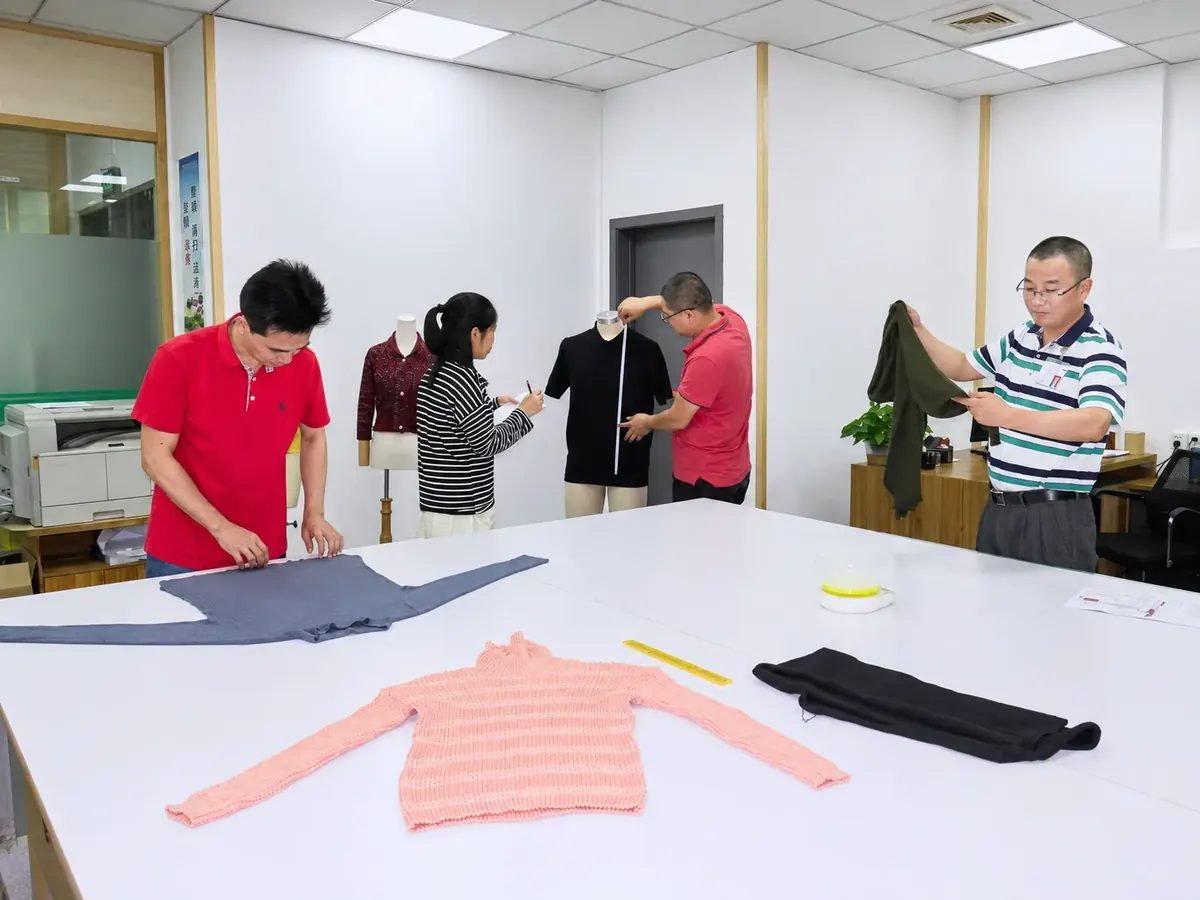
Control installation during bulk packing
Place an approved garment and clear visual instruction at the workstation. Separate fasteners by style or destination and prevent obsolete cards, prices or barcodes from returning to use. Operators should stop when a needle is bent, blunt or damaged, a fastener feeds poorly, the approved attachment point is inaccessible, or garment structure differs from the standard.
At first bulk and final inspection, sample across colors, sizes, packing operators and production timing. Verify correct tag and data, location, orientation, security, pack presentation and garment condition. Remove a defined subset to inspect hidden damage; checking only that every unit has a tag cannot find punctures or pulled yarn left underneath it.
Handle mistakes as garment defects
If a tag is placed incorrectly, do not simply cut it off and attach another beside it. Quarantine affected units, inspect the original point after removal and decide whether the sweater is acceptable, repairable or rejected under the buyer's defect rules. Re-tagging must not leave multiple holes, loose plastic pieces or unrecorded repairs.
Buyer hangtag-release checklist
- Tag content, artwork and data owner are identified.
- Retailer or fulfillment rules and revisions are supplied.
- The attachment point is shown by measurement and photo.
- Hardware, finished length, closure and tool are released.
- No exposed knit area is pierced by operator choice.
- The production-intended finished sweater is used for trial.
- Packing and reasonable handling are included.
- Post-removal garment condition is inspected.
- Bulk checks cover data, placement, security and damage.
- Incorrectly tagged units are held and dispositioned.
Yushengda can coordinate buyer-approved hangtags, labels and packing instructions for confirmed custom knitwear orders. The buyer or retailer must provide the correct ticket data, barcode authorization and channel requirements; the suitable attachment method depends on the actual garment. Use the label and packaging checklist, barcode validation guide and main-label approval guide, or send the hangtag file, attachment hardware, sweater sample details and receiving manual for project review.
Primary reference: Belk, National Brands Vendor Business Requirements, for an example of retailer-controlled hangtag placement and non-damaging ticket removal requirements. Confirm the current manual for the actual channel. Recent supplier and packaging articles were reviewed only to identify the gap between hangtag design and garment-safe installation; no competitor wording, figures, images, cases or claims were reused.