Approve a custom sweater knit-down only for the decisions it can physically demonstrate: the identified yarn, machine gauge, stitch structure, density, surface appearance, hand and stated trial finish. Label the swatch, measure it before and after the agreed treatment, and record approved boundaries. Do not use a small knit-down to approve garment fit, linking, trim attachment, full-panel distortion, production dye lots or finished-bulk consistency.
Define the question before requesting a swatch
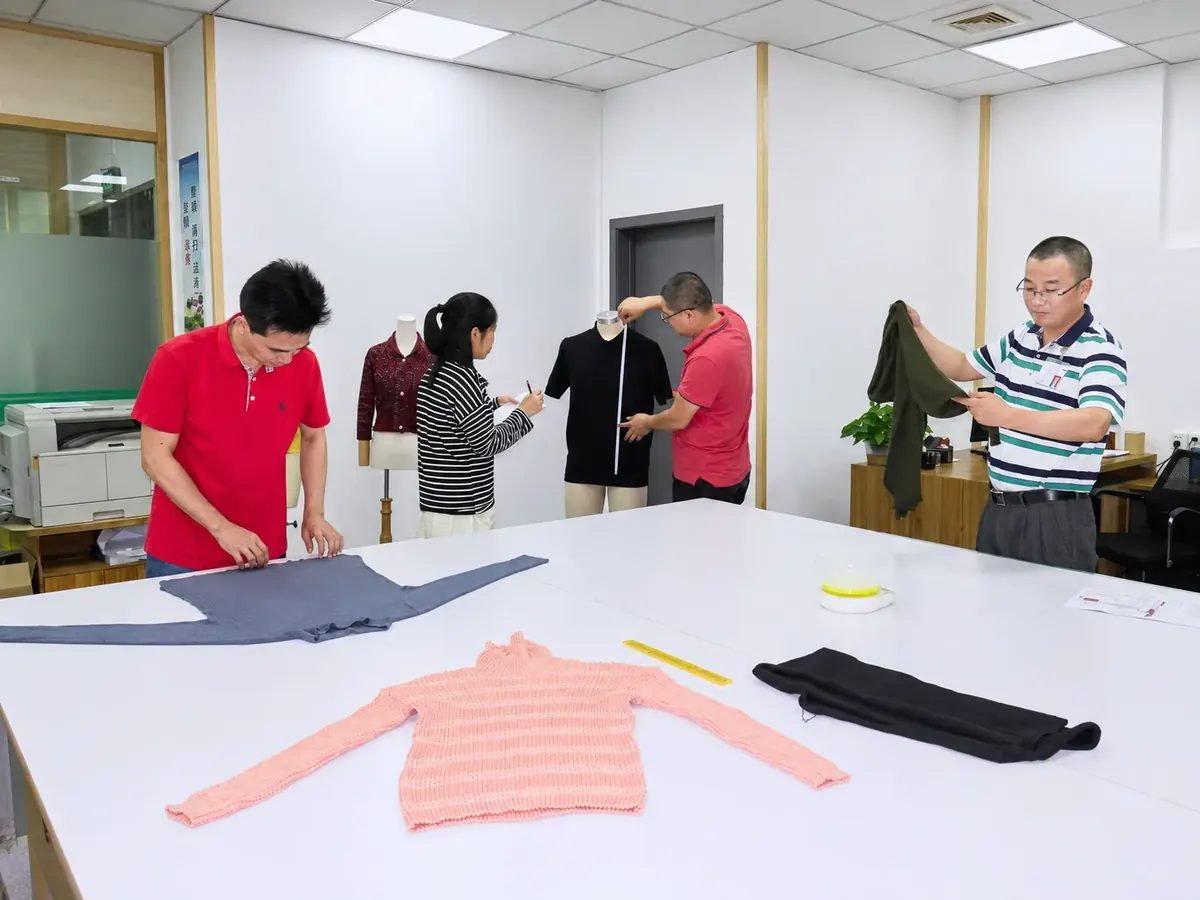
A knit-down is useful when the buyer needs to compare yarn options, see how a stitch renders, select density, judge a color combination, or screen a finishing direction before paying for a complete garment. Ask one submission to answer named questions. “Please send a swatch” is not a test plan.
State the style and revision, intended season, garment area represented, yarn direction, color, nominal gauge, stitch or artwork, number of ends, target hand and planned wash or specialty finish. If the supplier selects any variable, require it to be disclosed rather than allowing an attractive result to hide a different construction basis.
Identify every knit-down so it can be reproduced
Attach a durable label or controlled record with submission number, date, supplier yarn code, composition, count and ply, color reference, lot if known, machine gauge, stitch program or structure, ends fed and treatment status. Mark face, reverse, wale direction and the area intended for measurement.
| Decision | Evidence on the knit-down | What remains open |
|---|---|---|
| Yarn route | Identified composition, count/ply and supplier code | Bulk lot and claim verification |
| Structure | Gauge, stitch, density and face/reverse appearance | Full-panel shaping and seams |
| Color | Physical knitted appearance under stated light | Bulk-lot consistency and garment effects |
| Hand | Approved sample under named treatment | Repeatability after full production finish |
| Dimensions | Measured courses/wales and trial change | Finished garment measurements and fit |
Photograph the label and swatch together before cutting or couriering. Where buyer and supplier need working masters, agree whether matched pieces can be retained. A phone image may support discussion, but it cannot replace physical hand, thickness, stretch, color and surface review.
Review the construction, not just the first impression
Inspect the face and reverse for stitch definition, openness, ladders, visible yarn joins, floats, color interaction and unintended lines. Look near edges as well as the center; edge curl or distortion may signal behavior that a tightly framed photograph hides. For cable, pointelle, jacquard, intarsia or ribs, confirm repeat dimensions and orientation.
Count or measure stitches and rows only after agreeing the method and conditioning state. CottonWorks technical guidance for knitted fabrics explains the general relationship among yarn, machine cut or gauge and stitch length: construction variables interact, and tightening a stitch can change fabric width. Its cited material addresses knitting principles rather than a universal flat-bed sweater specification, so the buyer and manufacturer must define the project method.
Compare untreated and finished states
Record dimensions, weight if relevant, hand and appearance before the proposed wash, steam, brush, spray or other finish. Repeat the agreed observations after treatment and conditioning. Mark whether the swatch represents an exploratory finish, a target recipe or the production-intended process.
A small swatch has exposed edges and little garment mass, so its relaxation, curling, color distribution and mechanical action may differ from a full panel or linked garment. Use it to identify risk and select a route, then validate interactions on the appropriate finished sample. Do not calculate a universal garment shrinkage allowance from one uncontrolled swatch.
Write an approval with boundaries
Use a status such as approved, approved as a development direction, revise and resubmit, or rejected. List exactly what is accepted—for example, yarn reference, main-body structure and washed hand—and what is pending, such as final shade, rib recovery, artwork placement or complete-garment weight.
For a revision, state observed evidence and desired outcome rather than only “softer,” “tighter” or “more premium.” Ask the supplier to explain which variable will change and what consequence it may have for consumption, price, machine route, dimensions or lead time. Give the new submission a different number; never overwrite the approved identity.
Move from swatch approval to garment evidence
After selecting the route, update the tech pack and quotation basis. The garment sample should confirm silhouette, measurements, shaping, linking, trims, artwork placement, overall drape and the full finishing response. A production-intended pre-production sample or other agreed gate should close remaining variables before bulk authorization.
When bulk yarn arrives, reconcile its identity and lot controls against the purchase record. Use appropriate first-off panels, garments, testing and inspection for risks that a development swatch cannot represent. Approval is a sequence of bounded decisions, not one signature that transfers certainty to every later stage.
Buyer knit-down approval checklist
- The swatch has a unique submission and style revision.
- Yarn code, composition, count/ply, color and lot status are recorded.
- Gauge, stitch, ends and face/reverse orientation are identified.
- Untreated and finished states cannot be confused.
- Viewing, conditioning and measurement methods are stated.
- Structure, density, hand, color and artwork are reviewed separately.
- The accepted features and unresolved features are explicit.
- Any revision identifies the changed variable and commercial impact.
- The approved physical reference is retained and protected.
- Garment, bulk-lot and final inspection decisions have later gates.
Yushengda develops wool, cotton, acrylic, viscose, cashmere and blended knitwear across 3GG–16GG, subject to the design and yarn route. Use the yarn-count guide, gauge guide and sealed-sample guide, or send the yarn direction, stitch reference, target gauge and finish questions for a development feasibility review.
Primary reference: Cotton Incorporated's CottonWorks, Guide to Improved Shrinkage Performance of Cotton Fabrics, for the general interaction of yarn, machine cut/gauge and stitch length in knitted construction. It is not a project-specific flat-knit approval standard. Competitor content was reviewed only to identify buyer questions and content gaps; no wording, numbers, claims, images or templates were reused.