Compare sweater yarn quotes only after every supplier states the same count system, singles count, ply or number of ends, fiber composition, yarn construction and finished knit reference. A larger number can mean finer yarn in Nm or Ne but heavier yarn in tex or denier. “Two-ply,” “two ends held together” and an ambiguous notation such as 2/28 are not automatically equivalent.
Identify the count system before reading the number
Yarn count describes linear density—the relationship between yarn length and mass. CottonWorks groups common systems into two families. In direct systems such as tex and denier, the value represents mass for a fixed length, so a larger value generally means a heavier or coarser yarn. Tex is grams per 1,000 metres; denier is grams per 9,000 metres.
In indirect systems such as English cotton count (Ne) and metric count (Nm), the value represents length for a fixed mass. A larger value therefore means a finer yarn. CottonWorks defines Ne by 840-yard hanks per pound and Nm by 1,000-metre lengths per kilogram. Never compare “28” with “28” until the unit is written.
| System | Direction | What a larger number usually means | Buyer notation example |
|---|---|---|---|
| Tex | Mass per fixed length | Heavier/coarser linear density | State tex plus yarn construction |
| Denier | Mass per fixed length | Heavier/coarser linear density | State denier and filament/spun details |
| Ne | Length per fixed mass | Finer linear density | Write Ne explicitly, not only the number |
| Nm | Length per fixed mass | Finer linear density | Write Nm and clarify singles/ply notation |
Use conversions as a communication check, not a complete substitution approval. CottonWorks gives common relationships including Nm ÷ 1.69 ≈ Ne and denier ÷ 9 = tex. Rounding, commercial naming, moisture conditioning, blended fibers and actual yarn variability mean the converted number does not guarantee identical knitting performance or appearance.
Decode singles count and ply separately
A singles yarn is one spun strand. A plied yarn combines two or more singles through a further twisting operation. CottonWorks explains that plied spun yarn designations may place count and ply in different orders: 36/2 can describe two 36-count singles, while some long-staple or worsted conventions may write the ply first, such as 2/36. This variation makes a bare “2/28” unsafe in a buyer specification.
Ask the supplier to rewrite the notation in words: “two singles, each Nm 28, plied together,” followed by the supplier’s resultant-count convention if used. Confirm whether the stated count is for each single or the final folded yarn. Also record twist direction and level when commercially important, because plying can affect torque, uniformity, strength, softness and cost.
Do not confuse plied yarn with multiple ends fed together
Two ends can be delivered in parallel to a knitting machine without being twisted into one plied yarn. CottonWorks calls these “doubles” and distinguishes them from a true plied construction. Both approaches may produce a similar nominal combined linear density, yet they can behave differently in feeding, stitch formation, surface uniformity and torque.
Write “factory feeds two ends together” only when that is the approved construction. State whether both ends must come from the same yarn code, shade lot and package condition, and how they are controlled through bulk. If one supplier quotes a true two-ply yarn and another quotes two singles held together, their prices are not based on identical inputs.
Count alone does not define sweater thickness
Fiber density, staple or filament form, spinning system, twist, hairiness, loft, finishing and moisture condition affect the yarn’s apparent diameter and behavior. Wool, cotton, acrylic, viscose, cashmere and blends at converted equivalent counts should not be assumed to occupy the needle bed or finish identically.
The knitted result also depends on machine gauge, stitch structure, stitch length, take-up, number of ends, panel dimensions and washing or finishing. A cable consumes and displays yarn differently from jersey; rib contracts differently; brushing can add visual bulk without changing the original count. Gauge and yarn count must be developed together rather than selected from a generic chart.
Normalize supplier quotes before comparing price
Give every supplier one comparison sheet. If the exact yarn is nominated, include mill or supplier, yarn code, fiber percentages, color reference, count system, singles count, ply, twist or effect construction, finish and certification evidence required for that order. If equivalents are allowed, require suppliers to disclose every departure rather than writing “same quality.”
- Convert counts into one reference unit for desk comparison.
- Keep the supplier’s original notation beside the conversion.
- Separate singles count, true ply and number of ends fed.
- Compare fiber, spinning route, twist, finish and color route.
- Confirm machine gauge, stitch and target finished weight.
- Request yarn price basis, minimum, stock status and color cost.
- Identify wastage, sampling and bulk consumption assumptions.
- Approve a labeled knit-down before treating quotes as equivalent.
A lower price may reflect a different resultant thickness, fewer ends, a stock shade, a different blend, a looser stitch density or an untreated yarn. Those alternatives may be commercially sensible, but they must be visible. Do not force suppliers into the same unit price while leaving the yarn specification open.
Approve yarn through a controlled knit-down
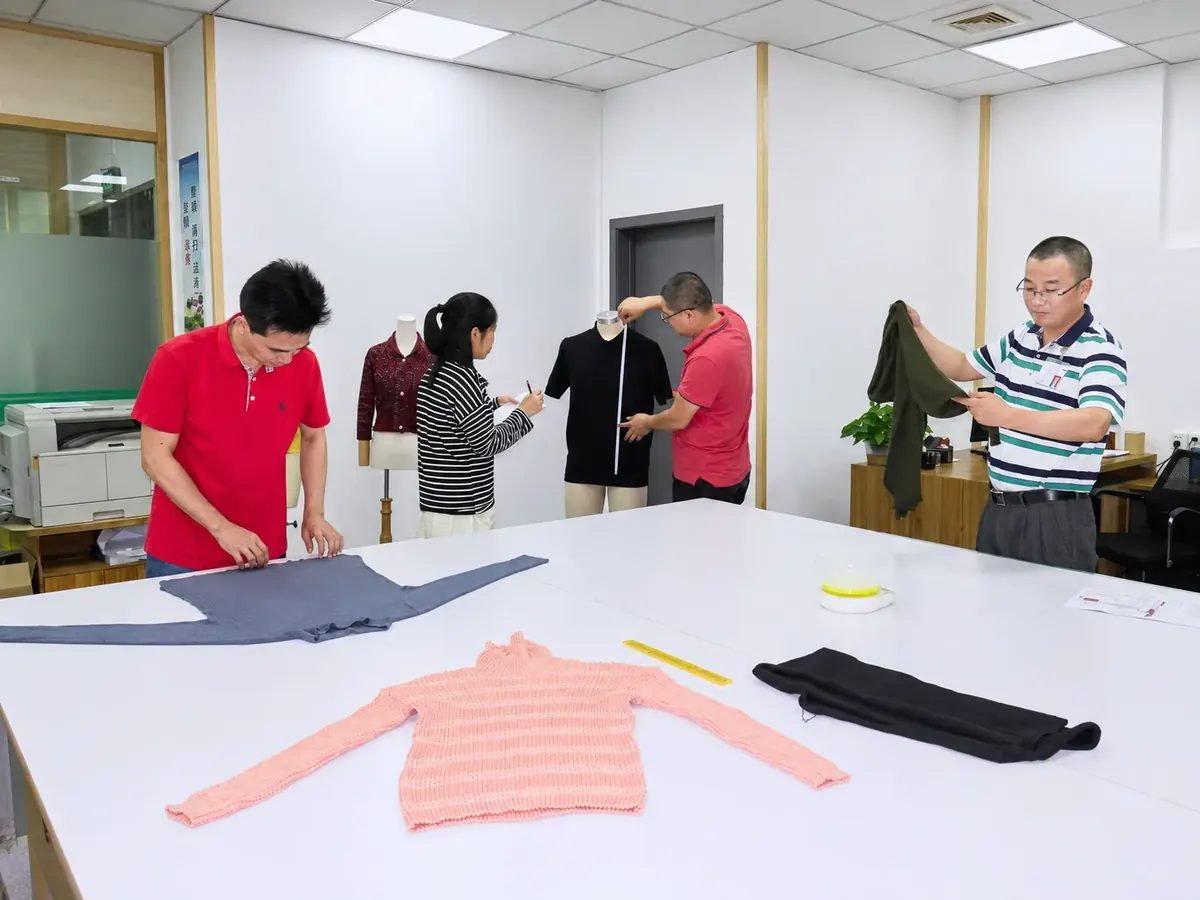
Ask for a representative panel made with the proposed yarn, number of ends, machine gauge, stitch and planned finish. Label it with supplier, yarn code, composition, count notation written in words, color/lot, gauge, structure, date and sample revision. Assess appearance, stitch clarity, coverage, hand feel, recovery, weight and dimensions after the relevant finish.
A small swatch cannot answer every garment question. Cables, intarsia, jacquard, fashioned edges, ribs and seams may need separate areas or a full sample. Performance requirements such as pilling, dimensional stability and colorfastness require their specified test methods. Approving count and appearance does not automatically approve those outcomes.
Lock bulk identity and substitution controls
Once approved, place the exact yarn identity and construction in the purchase order, tech pack or controlled approval record. Keep a sealed yarn sample or labeled cone reference and the approved knit-down. For bulk, reconcile delivered yarn code, color and lot with the order and decide how mixed lots will be managed.
Any change in mill, code, composition, count system, singles count, ply, number of ends, twist or finish should trigger technical review. A supplier may propose a converted “equivalent,” but equivalence must be demonstrated in the intended knit and finish—not declared from arithmetic alone.
Sweater yarn quote checklist
- Count system is explicitly written as Nm, Ne, tex, denier or another named unit.
- Singles count and final construction are stated in words.
- True ply is distinguished from multiple ends fed together.
- Fiber percentages, yarn code, spinning route and finish are identified.
- Gauge, stitch, number of ends and finished target are linked.
- Conversion is used only for comparison, not automatic approval.
- A labeled finished knit-down supports the selected quote.
- Bulk yarn identity and substitution approval are controlled.
Yushengda develops custom knitwear in wool, cotton, acrylic, viscose, cashmere and blends across 3GG–16GG, subject to the yarn and project. Use the 3GG–16GG gauge guide, the yarn substitution guide, or send your reference swatch, composition, target hand feel and order quantity for a project-specific discussion.
Technical references: CottonWorks’ Yarn Ply, Counts and Treatments and Textile Yarns resources; and ISO 2060:1994, the current skein method for determining linear density of yarn from packages, last confirmed in 2025. Use qualified yarn and laboratory guidance for a specific specification.