Approve custom sweater hand feel by defining separate attributes—such as softness, smoothness, bulk, surface hairiness, stiffness, drape and prickliness—then comparing conditioned, anonymized samples in a fixed sequence against an identified physical reference. Lock yarn, knit construction and finishing, and agree how bulk lots will be sampled and judged. “Soft,” “luxury” or “same as sample” alone is not reproducible.
Break hand feel into attributes people can compare
Hand is a combined sensory response, not one property. Ask what the customer should perceive: soft versus harsh, smooth versus rough, full versus flat, flexible versus stiff, dry versus slick, lofty versus compact, clean versus hairy, cool versus warm, or non-prickly versus irritating. Choose only attributes relevant to the product.
Define each word with physical anchors. For example, “surface hairiness” can refer to visible and tactile fiber ends, while “bulk” describes perceived volume relative to mass. Do not use “cashmere feel” as a test method or imply a fiber identity from touch. Composition and hand require separate evidence.
| Attribute | Buyer question | Related controls to review |
|---|---|---|
| Softness/harshness | How gentle does the surface feel? | Fiber, yarn, finish and care state |
| Bulk/compressibility | How full does it feel when squeezed? | Yarn loft, structure, density and brushing |
| Smoothness/hairiness | Is the surface clean, fuzzy or uneven? | Fiber length, yarn construction and raising |
| Stiffness/drape | Does the garment fold and hang as intended? | Gauge, stitch, weight, finish and dimensions |
| Prickliness | Does contact create localized discomfort? | Fiber/yarn choice, protruding ends and wearer sensitivity |
Standardize how people touch and compare samples
AATCC EP5-2025 provides guidelines for presenting fabrics and standardizing the conditions under which one or more components of hand are evaluated. It supports repeated evaluation by different people, evaluator training and panel comparison. Use the licensed procedure when it applies, or build a project protocol with a qualified textile specialist.
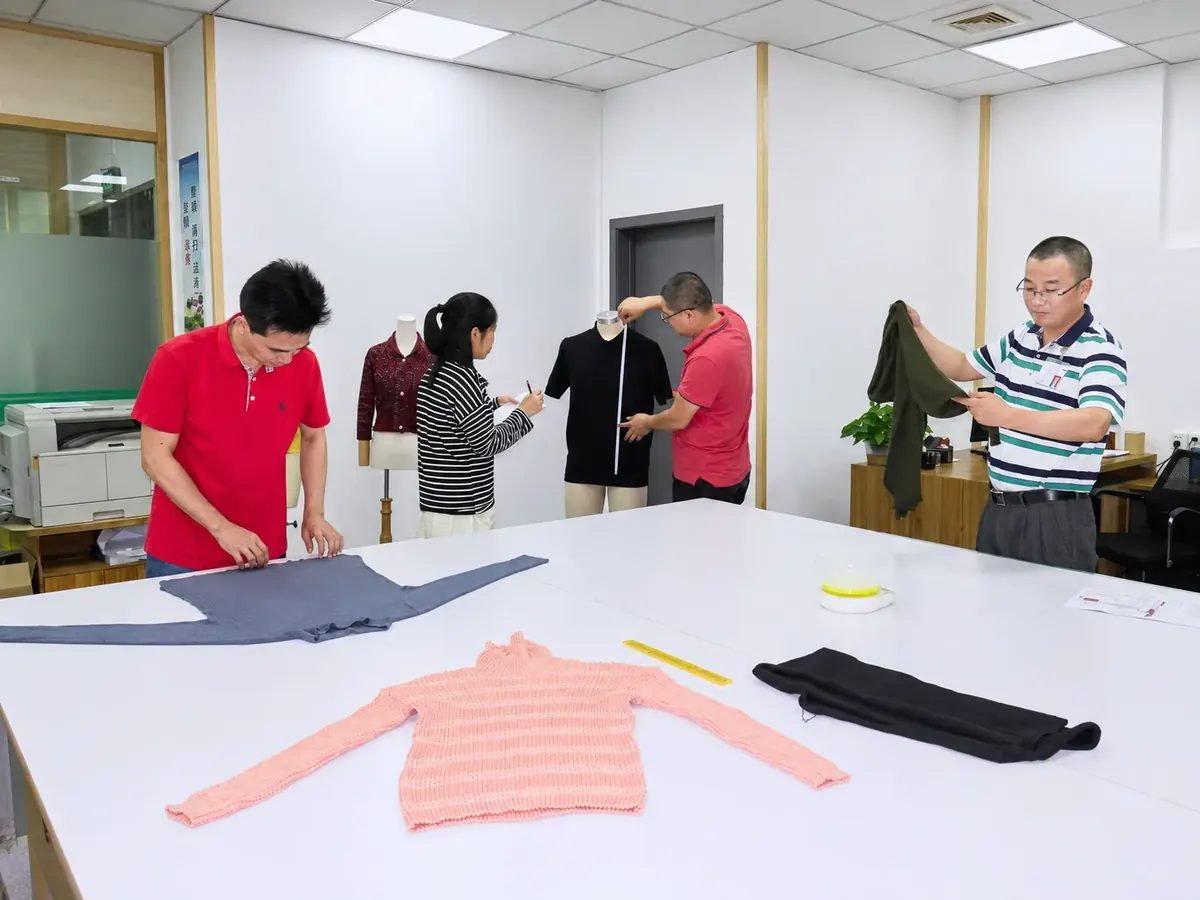
Control lighting, room conditions, sample conditioning, specimen size or garment area, presentation order, handling sequence and evaluation time. Remove brand or supplier clues where practical and randomize coded samples. Evaluators should not discuss scores until individual results are recorded, because price, fiber claims and another person’s opinion can bias judgment.
Use the right reference for the decision
A competitor garment may communicate direction but should not be copied and may have unknown composition, age, care history or finish. Create an approved reference from the project’s final yarn, gauge, stitch, construction and finish. Label style, color, size, sample version, date and approval status, then store it clean, dry and protected from uncontrolled handling.
One reference does not define every acceptable variation. If the buyer can tolerate a range, retain boundary references or a scored scale showing acceptable, borderline and unacceptable examples. Replace aged or contaminated references through a documented process rather than letting a worn showroom sample become the permanent standard.

Lock the technical causes behind the approved hand
Record yarn supplier/code, composition, count and ply, number of ends, color or lot plan, machine gauge, stitch structure, stitch density or program controls, and finished garment weight. Similar fiber percentages can feel different when yarn twist, loft, hairiness or structure changes.
Document the finishing route: wash chemistry where appropriate to the controlled production file, liquor and mechanical conditions, temperature, time, drying, softening, brushing, steaming, pressing and cooling. Buyers do not need proprietary formula disclosure to state the approved outcome, but the factory needs a repeatable internal process. Any yarn or finish substitution should trigger renewed hand and performance review.
Approve hand together with performance
A softer result is not automatically better. Additional softening or looser construction may affect appearance, dimensional stability, rib recovery, shedding, pilling, seam behavior or color performance. Review the approved hand alongside the product’s required tests and after the intended care cycle.
Evaluate both new and cared samples when after-care feel matters. State the laundering or cleaning method, number of cycles, conditioning and evaluation interval. A brushed surface may feel plush initially yet change after abrasion or cleaning; a washed wool blend may soften while dimensions move.
Build a panel and decision rule
Select evaluators who understand the target customer and train them on attribute definitions and references. Use individual score sheets with coded samples. Decide in advance whether the result is based on median score, agreement by a defined majority, distance from the reference or another qualified rule. Avoid changing the rule after seeing supplier results.
When instrumental comparison is appropriate, AATCC lists TM202 for relative hand value and TM218 for multi-module determination of tactile sensations. Instruments can add repeatable mechanical data, but they do not automatically represent whole-garment comfort, seams, ribs, fit or every consumer perception. Define specimen location and interpretation with the laboratory.
Transfer the approval into bulk control
Check first production pieces after the final intended finish before all goods are completed. Sample across yarn lots, colors, machines or production groups and finishing batches according to risk. Compare under the same conditions used for approval and retain coded results.
If bulk differs, map findings to yarn identity, weight, density, finish batch, moisture/conditioning and process records. Do not correct a hard hand by adding an unapproved softener or reprocessing the full order without checking color, dimensions, performance, labeling implications and buyer authorization.
Buyer checklist for hand-feel approval
- Relevant attributes replace vague words such as premium.
- Each attribute has a shared definition and reference.
- Samples are conditioned, coded and handled consistently.
- Yarn, gauge, stitch, weight and finishing are locked.
- The approved reference is identified and stored correctly.
- New and after-care hand are reviewed where relevant.
- Softness is checked alongside pilling, shrinkage and recovery.
- Panel members score independently under a preset rule.
- Bulk sampling covers material and finishing variation.
- Substitution or reprocessing requires renewed approval.
Yushengda develops custom knitwear in wool, cotton, acrylic, viscose, cashmere and blends across 3GG–16GG, subject to the project. Use the sweater weight-control guide, the pilling-risk guide, or send your reference sample, yarn direction, target feel, care method and quantity for an RFQ discussion.
Technical references: AATCC EP5-2025, Fabric Hand: Guidelines for the Subjective Evaluation, and the AATCC standards directory listing TM202 and TM218 instrumental methods. Licensed methods and project-specific acceptance rules should be selected with qualified textile guidance.