A sweater reorder can be matched closely, but a new yarn or dye lot should not be promised as visually identical without fresh approval. Preserve an unexposed master standard and first-order production evidence, then compare the new lot on the same material, gauge, stitch and finish under agreed viewing and instrumental conditions. Set the commercial tolerance and lot-mixing rule before knitting.

Define what “match the original” means
The target could be the original approved color standard, an approved lab dip, a retained bulk yarn submit, a finished first-order sweater or current stock in the warehouse. These references may no longer agree. A worn or displayed garment can change through light, care, storage and handling, while a paper color reference does not reproduce knitted texture.
Choose one controlling master and state the role of supporting references. If the reorder must sit beside old inventory, compare against representative current stock as an additional commercial check, but do not silently replace the protected master with one aged garment.
| Reference | Useful for | Main limitation |
|---|---|---|
| Protected master standard | Long-term color target | Must be identified, stored and monitored |
| Approved lab dip/yarn submit | Dyeing approval trail | May not show final stitch and finish |
| Retained finished sweater | Complete visual appearance | Can age or change in storage |
| Current warehouse stock | Side-by-side retail compatibility | May contain several first-order lots |
| Digital photo/screen | Communication and triage | Not a controlled color standard |
Rebuild the material identity before color approval
Confirm fiber composition, yarn reference, count, ply, twist, supplier, dye route and any approved substitution. Then confirm gauge, number of ends, stitch structure, density, garment weight direction and finishing. The same nominal color can look different when loop size, surface hair, luster or stitch shadows change.
If the original yarn is discontinued, treat the new yarn as a material substitution, not merely a color match. Approve a finished knit panel or garment and reassess hand, weight, dimensions, care and performance alongside shade.
Preserve evidence from the first order
Archive the master identity, supplier and color codes, approved lab dips, bulk yarn submit, yarn and finish lot numbers, physical knit references, instrument data, viewing conditions, sample comments and accepted light/dark boundaries. Record which lots entered which styles or cartons.
Protect physical references from light, contamination, moisture and uncontrolled handling. Date them and define replacement or verification rules. A reference is not reliable merely because it remains in an envelope; compare working standards with the protected master when repeated use or age could change them.
Use visual and instrumental review for different jobs
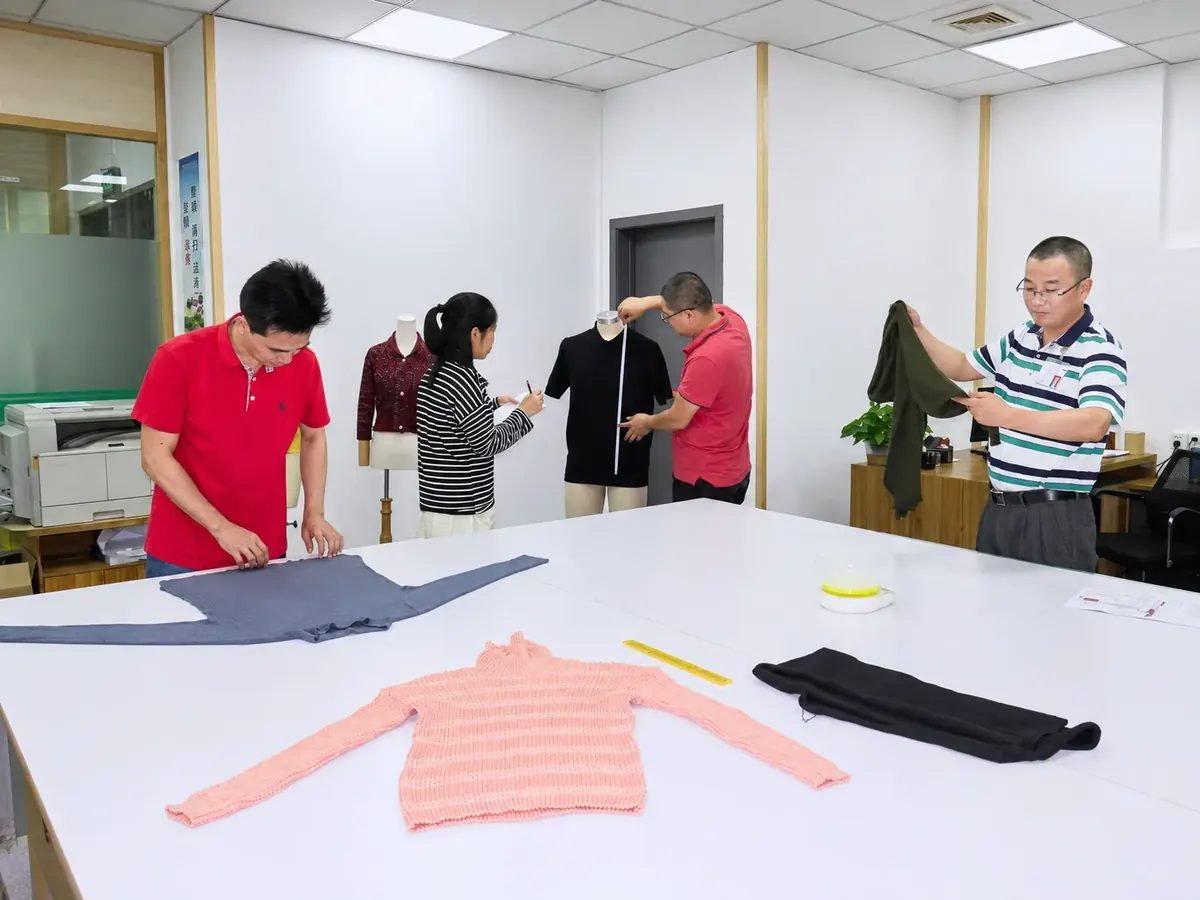
Visual assessment can reveal metamerism, texture effects, panel mismatch and commercial appearance. Define light source or sources, viewing cabinet, background, observer approach and specimen orientation. Compare like with like: yarn to yarn, finished knit to finished knit, and garment to garment where applicable.
ISO 105-J03:2009 provides a calculation for color difference between two specimens of the same material measured under the same conditions, expressed as CMC total color difference. It also supports a maximum tolerance based on the closeness of match required for the end use. The buyer must still specify measurement conditions and the project tolerance; the standard does not supply one universal sweater limit.
Do not use the grey scale for the wrong question
ISO 105-A02:1993 describes the grey scale for assessing change in color in colorfastness tests. That is useful when judging how a specimen changes after a defined exposure. It does not by itself quantify whether a fresh reorder dye lot matches the original production shade.
Keep three decisions separate: initial color match, within-lot or between-lot shade variation, and colorfastness after washing, rubbing, light or another exposure. Passing one does not prove the other two.
Approve the new bulk lot before full knitting
Request a new lab dip or bulk yarn submit when the dye route requires it, even if the recipe and color name are unchanged. Knit a representative panel using the intended gauge and structure, complete the proposed wash or specialty finish and compare it with the controlling references.
For washed, brushed, spray-finished or mixed-stitch styles, approve the finished appearance rather than only raw yarn. If multiple garment styles share a signature color, decide whether they must match side by side and whether different structures require separate visual standards.
Control lots inside the reorder
Identify yarn dye lots and shade groups before issuing yarn to production. Avoid mixing visibly incompatible lots within one garment—for example, sleeves from one group and body panels from another. Record any planned allocation by style, size, production batch or carton.
If more than one acceptable shade group must ship, define whether groups can be mixed in the same retail delivery. A wholesale floor set, matching family program or coordinated outfit may need tighter segregation than an online replenishment released at a different time.
Make the commercial decision explicit
Before the result is known, state who can approve an off-standard lot and what evidence is required. Possible decisions include approve as standard, approve with lot segregation, approve for a separate delivery, rework or redye where technically appropriate, or reject. Assess any corrective dyeing or finishing for hand, dimensions, fastness and performance.
Do not hide a changed shade under the same SKU when customers are likely to receive mixed stock and expect matching. If the accepted difference is commercially meaningful, the brand may need separate inventory, launch timing or product communication.
Buyer reorder-color checklist
- A protected master and supporting references are identified.
- Current stock is treated as a commercial check, not automatically the master.
- Yarn, gauge, stitch and finish match the approved route.
- Any yarn change follows substitution approval.
- Visual conditions and instrumental conditions are written.
- The CMC formula and tolerance are project-specific.
- Initial match, lot variation and colorfastness are separate decisions.
- The new bulk lot is approved before full knitting.
- Shade groups are traced and incompatible panels are not mixed.
- Retail allocation and off-standard authority are defined.
Yushengda develops custom knitwear in wool, cotton, acrylic, viscose, cashmere and blends across 3GG–16GG, subject to the project. Use the first-order color approval guide, the yarn substitution guide, or send your retained standard, original yarn reference, reorder quantity and required delivery for an RFQ discussion.
Primary references: ISO 105-J03:2009, Calculation of colour differences, confirmed current in 2025, and ISO 105-A02:1993, Grey scale for assessing change in colour, also confirmed current in 2025. Competitor reorder and dye-lot guides were reviewed only for coverage gaps; no proprietary tolerances, cases, claims, images or wording were reused.