Specify children's sweater cords only after fixing the destination market, product type, intended age and size, and whether the garment is upper outerwear. Map every functional cord, decorative cord, loop, tie, belt, toggle and free end by body zone. Apply the current market rule or standard to that exact classification, then verify the production-intended garment before bulk and again after finishing.
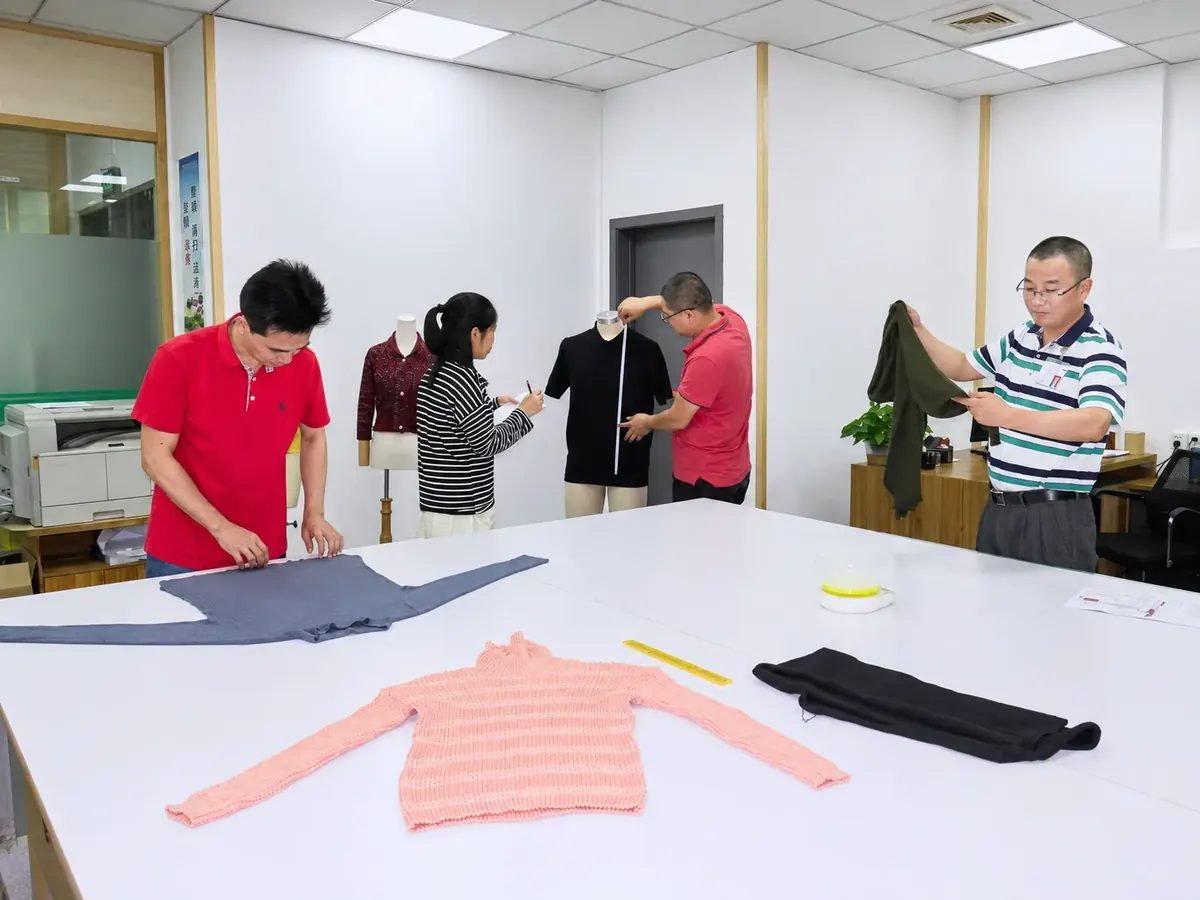
Classify the garment before measuring a cord
Record each sales market, stated age, labeled size and equivalent sizing, intended use, layering position and product description. A cardigan, hooded sweater, knitted jacket, poncho, dress and sleepwear item may not follow the same requirement. Marketing, imagery and labeling can affect how an ambiguous product is understood.
For the United States, the CPSC describes “upper outerwear” as clothing such as jackets and sweatshirts generally intended to be worn outside other garments. Its drawstring rule addresses specified children's upper-outerwear size ranges. Do not assume every knitted top is covered identically—or assume an ambiguous hooded knit is outside scope without qualified review.
| Input | What to record | Why it matters |
|---|---|---|
| Market | US, EU member state or other destination | Requirements and responsible parties differ |
| Age/size | Intended age, label and equivalent size | Restrictions depend on the child category |
| Garment type | Upper outerwear, ordinary knit, sleepwear, costume | Changes the applicable rule set |
| Body zone | Head/neck, chest, waist, hem, sleeve, back | Different entanglement scenarios apply |
| Feature | Drawstring, fixed loop, tie, belt, toggle, tab | Construction and protrusion are evaluated differently |
Apply the US upper-outerwear rule exactly
CPSC states that children's upper outerwear in sizes 2T to 12 or equivalent with neck or hood drawstrings presents a substantial product hazard. Its business guidance therefore should be checked before placing any functional or decorative cord at the head or neck of an in-scope knitted outer garment.
For waist and bottom drawstrings on children's upper outerwear in sizes 2T to 16 or equivalent, CPSC guidance limits extension outside the channel to 3 inches when the garment is expanded to its fullest width, prohibits toggles, knots and other attachments at free ends, and describes bartacking at the midpoint so the cord cannot be pulled through. Use the current official rule and qualified advice for the exact product rather than treating this paragraph as a complete legal checklist.
Use the current EU standard, not US dimensions
The EU's published standards information identifies EN 14682:2014, Safety of children's clothing—Cords and drawstrings on children's clothing—Specifications, in connection with the General Product Safety Regulation framework. The standard covers body zones and child categories more broadly than a simple copy of the US upper-outerwear rule.
Obtain the current licensed standard and verify its status for the target market and date. Classify the child's age group, garment zone, cord type, protruding length, free ends, loops, attachment and adjustment device using that document. A garment built to one US dimension is not automatically acceptable in the EU.
Map every cord-like feature in the tech pack
Create a drawing that marks hood edges, necklines, shoulder areas, chest, waist, hem, sleeves, cuffs, back, pockets and belts. Number every cord, tie, loop and tab. Record material, construction, elasticity, width, total length, exposed length, attachment, channel, free-end treatment, toggle and intended function.
Do not omit “decorative” features. A knitted tie, pom-pom cord, faux drawcord, narrow belt, hanger loop or fixed bow can still form a protruding end or loop. Evaluate the finished three-dimensional feature, not only the flat artwork. Also assess whether a stretch knit changes the exposed length when worn.
Choose safer design alternatives early
Where a cord is prohibited or creates unnecessary risk, redesign before sampling. Depending on product and market, alternatives may include fixed decorative elements that cannot form hazardous protrusions, elasticated structures, rib shaping, snaps, zippers or other closures reviewed for their own hazards.
A replacement is not automatically safe. Toggles and detachable pieces can introduce entrapment or small-part concerns; elastic loops can stretch; zipper pulls and ornaments can catch; long knitted belts can remain exposed. Run a fresh risk assessment after every design change.
Measure the production-intended sample
Use the final yarn, gauge, stitch, size, channel, attachment, trims and finishing route. Measure in the exact garment condition required by the applicable method—relaxed, expanded or otherwise specified—and record the endpoints. Check the smallest and largest risk sizes instead of assuming one sample covers the grade.
Pull cords through their intended adjustment, inspect whether knots or end attachments exist, confirm midpoint securing where required, and assess loops created during ordinary use. Wash or finish the garment as specified, then remeasure because relaxation, shrinkage or growth can alter protrusion.
Control components and changes in bulk
Lock cord material and dimensions, knitting or supplier reference, attachment method, channel length, bartack or securing details, toggle status, artwork revision and size rule. A substitute cord with greater stretch or a different end treatment can invalidate the approved result even when its color matches.
Verify first bulk garments across relevant sizes and colors. During final inspection, measure the specified features using the controlled method and treat a prohibited cord, missing securing operation or unauthorized attachment through the agreed safety escalation—not as an ordinary cosmetic defect averaged into AQL.
Keep product safety evidence connected
Retain classification rationale, market and age/size scope, risk assessment, drawings, component records, approved sample identity, measurements, test or technical review where required, change history, production checks and release decision. EU GPSR responsibilities and US children's product obligations may require additional technical and traceability records beyond cord measurements.
Do not print “CPSC approved” or “EU certified” based on an internal checklist; regulators generally do not approve individual garment designs through this sourcing workflow. The responsible business should determine applicable certification, documentation and importer obligations for the destination.
Buyer cord-safety checklist
- Market, age, size and garment classification are written.
- Every cord, loop, tie, belt, tab and toggle is mapped.
- US upper-outerwear rules are applied only to their scope.
- EU review uses the current licensed EN 14682 and GPSR context.
- Head, neck, waist, hem, sleeve and back zones are separate.
- Decorative features receive the same hazard review.
- Production-intended risk sizes are physically measured.
- Finishing and care effects are included.
- Substitution and construction changes trigger reapproval.
- Safety failures follow a critical escalation and release record.
Yushengda develops custom knitwear, including child and baby categories subject to project review, in wool, cotton, acrylic, viscose, cashmere and blends across 3GG–16GG. Use the trim approval guide, the compliance-plan guide, or send your target markets, age/size range, garment drawings, cord details and quantity for an RFQ discussion. Buyers remain responsible for confirming current legal requirements with qualified specialists.
Primary references: US CPSC, Drawstrings in Children's Upper Outerwear and its rulemaking page; European Commission standards information identifying EN 14682:2014 under the GPSR standards framework. Competitor content was reviewed only for topic gaps; no claims, cases, images or wording were reused.