Most custom sweaters should be evaluated for folded packing first, but the correct choice depends on garment weight, knit recovery, surface details, fold sensitivity, retail presentation and the receiving network. Garment-on-hanger transport is not simply “premium packaging”: it requires compatible hangers, covers, rails, warehouses and delivery vehicles. Approve both options through a packing-and-transit trial, then compare total landed handling rather than carton cost alone.

Separate display, storage and international transport
A sweater photographed or presented on a hanger has not necessarily been designed to remain suspended for weeks. Garment-on-hanger, often shortened to GOH, is a logistics system in which garments move on hangers and rails or racks instead of being folded into export cartons. It changes factory packing, vehicle cube, warehouse equipment, delivery route and store handling.
Ask the buyer’s freight forwarder, warehouse, retailer or 3PL whether the entire route can accept GOH. If an ocean or road leg, cross-dock or parcel carrier converts the units back into cartons, the added hanger work may not deliver the intended benefit. Likewise, a retailer may require a specific hanger, size marker, cover, barcode position and orientation that cannot be guessed from the garment style.
Start with the sweater’s physical behavior
Assess finished garment weight, shoulder construction, neckline stability, hanger contact points, stitch openness, recovery, applied trims and specialty finish. A heavy or open knit may lengthen or develop shoulder impressions on an unsuitable hanger. A brushed surface, embroidery, sequins or three-dimensional trim may be vulnerable to pressure or abrasion when folded. Neither method is universally safer.
Use the final yarn, gauge, size and wash route in the trial. A lightweight 16GG cardigan and a heavy 3GG oversized pullover cannot share a packing rule merely because both are sweaters. Check the largest and heaviest size, because it may create the highest hanger load or the largest folded pack.
| Decision factor | Folded flat pack | Garment-on-hanger |
|---|---|---|
| Garment support | Weight rests through the folded body | Weight concentrates at hanger contact points |
| Volume | Carton cube can be measured and optimized | Needs rail space and specialist capacity |
| Presentation | May require unfolding, hanging or light recovery work | Can reduce store preparation when the full route stays hanging |
| Surface risk | Pressure, fold lines, transfer or snagging between units | Shoulder marks, stretching, swing, contact and cover abrasion |
| Receiving | Carton, assortment and pallet rules apply | Hanger, rail, cover and sequence rules apply |
Build a realistic flat-pack trial
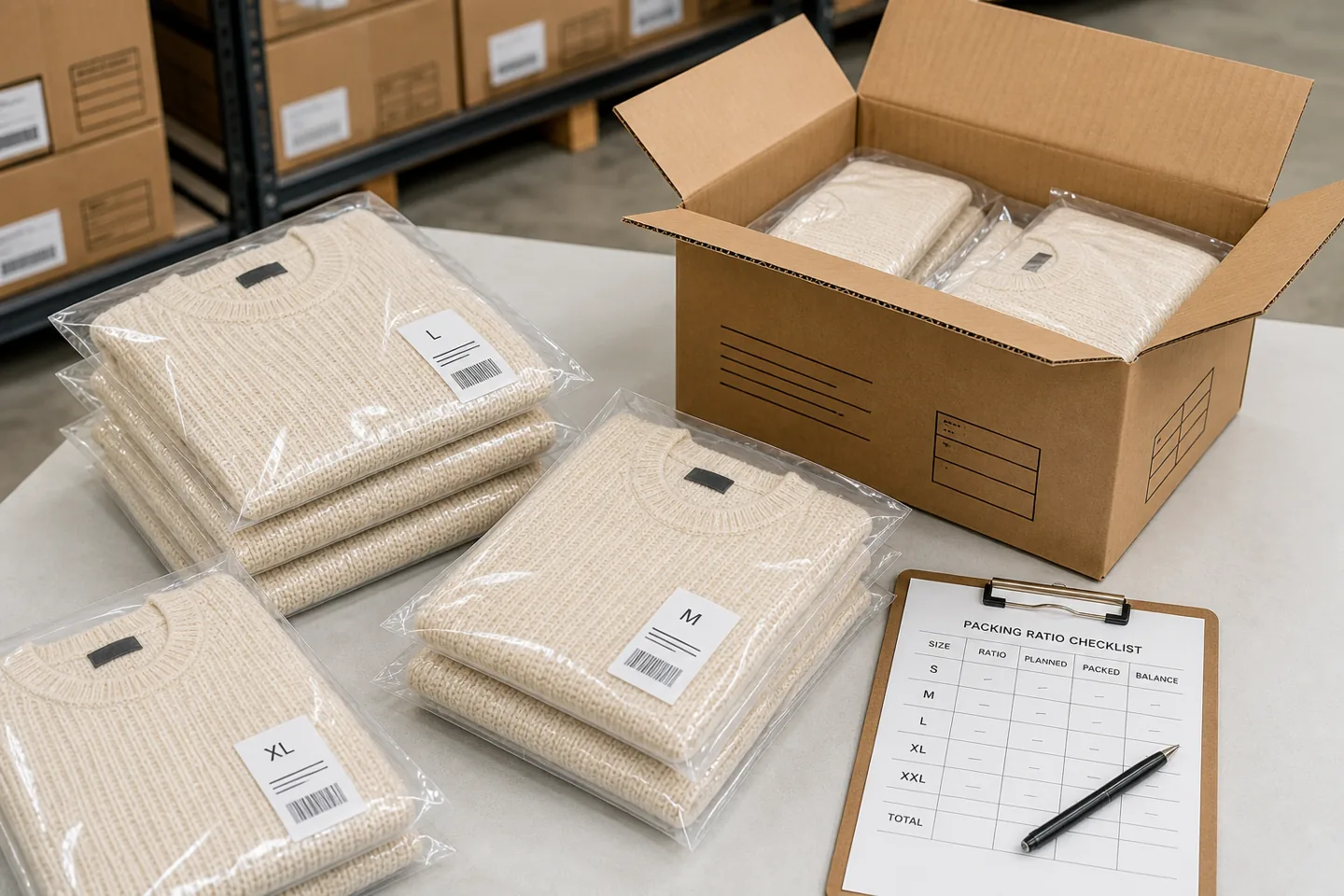
Define fold sequence, finished dimensions, tissue or insert position, closure, polybag size, quantity per carton, assortment and stacking direction. Pack the actual color-size range and hold the carton under representative compression and duration. After opening, inspect measurements, body and sleeve fold lines, collar, rib recovery, surface, decoration, button or zipper marks, color transfer and time needed to prepare the garment for sale.
Do not solve excessive carton cube by compressing the sweater without a product trial. Vacuum or heavy compression can affect loft, hand, creasing, trims and recovery. Do not invent a universal recovery time; agree what is acceptable after the actual route and receiving process.
Build a complete GOH trial
Specify the hanger model, width, profile, hook, material, clips if any, size marker, garment attachment route and protective cover. Check that the hanger supports the garment without distorting shoulders, neckline, waist or hem. For cardigans, agree whether closures are fastened; for sets, define how pieces remain together; for long or oversized knitwear, confirm floor clearance and rail spacing.
Simulate the planned hanging duration, movement and handling. Inspect shoulder peaks, hanger impressions, growth in body or sleeve length, neckline shape, seam strain and cover friction. Confirm how units will be counted, scanned, sequenced, sealed and protected through the vehicle and warehouse. A suitable hanger in a showroom is not evidence that a mixed logistics route will preserve the result.
Compare the total receiving cost
Calculate more than freight. For flat pack, include cartons, bags, cube, unpacking, sorting, hanger application, recovery, steaming or pressing where permitted, waste handling and delayed store availability. For GOH, include approved hangers and covers, lower packing density, rail equipment, specialist transport, warehouse compatibility, hanger return or disposal and any conversion point.
Use a route-specific comparison instead of copying a percentage from another business. A regional retail replenishment lane may value ready-to-rack delivery, while a long international route for low-MOQ sweaters may favor controlled flat packing. One brand can legitimately use different methods by style, channel or destination.
Lock the decision before bulk packing
Put the selected method in the purchase order and packing manual. Approve photos and a physical packed sample showing fold or hanger route, labels, size marker, cover, unit dimensions and carton or rail arrangement. Define inspection checks and who can approve substitutions. A change in hanger, polybag, carton quantity or folding board can alter the trial result and should be reviewed before use.
Buyer flat-pack or GOH checklist
- The end-to-end route and receiving capability are confirmed.
- Final yarn, gauge, wash, largest size and trims are represented.
- Flat-pack fold, bag, carton and compression are trialed.
- GOH hanger, cover, rail and handling route are trialed.
- Measurements, shoulders, neck, ribs, surface and recovery are checked.
- Barcode and assortment rules match the chosen method.
- Freight cube and destination handling are costed together.
- Mixed or conversion points have written instructions.
- Approved packing evidence is retained.
- No packing component is substituted without review.
Yushengda can coordinate buyer-approved folded packing, labels, cartons and inspection requirements for confirmed custom knitwear orders. GOH feasibility must be confirmed with the buyer’s receiving network and logistics providers; this article does not claim a dedicated GOH transport service. Use the carton test guide, polybag guide and barcode validation guide, or send the sweater specification, destination and receiving manual for packing coordination.
Planning references: The Fashion Pact, Packaging Guide, for examples of transport-hanger and flat-pack considerations; and the publicly available Best&Less Packaging and Marking Standards, as an example showing that retailer-specific packing instructions must be confirmed rather than generalized. Apply the actual buyer’s current manual. Competitor logistics articles were reviewed only for decision coverage and content gaps; no wording, cost figures, cases, images or claims were reused.